.svg)
Published: 11 March 2015
Category: News
The DALI lighting protocol has been around since 1984 and has become widely used as a standard throughout the world. But with the ‘Internet of Things’ now expanding fast, how will DALI fit into the lighting scheme of things? James Hunt reports:

Smart control of household lighting as part of building automation and the smart home has been a dream and even a sometimes difficult reality for over 50 years, but the Digital Addressable Lighting Interface (DALI), accepted as an international standard in 2002, has made things a lot easier.
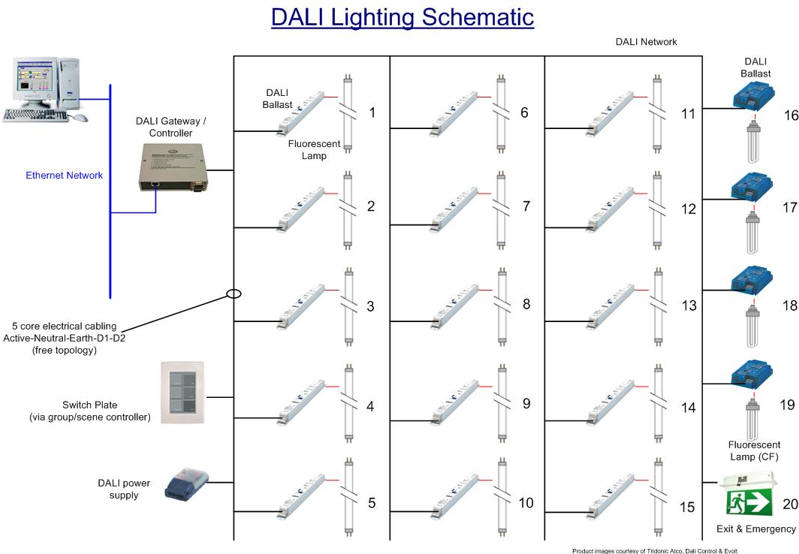
DALI is the now well-known data protocol and transport mechanism that was jointly developed and specified by several manufacturers of lighting equipment, including Philips Lighting. DALI’s common platform enables lighting equipment from different manufacturers to be connected together.
The capabilities of DALI lighting controls are ideally suited to commercial buildings - particularly hotels - but an increasing number of large domestic homes have also turned to DALI for lighting control. There are many and varied reasons for DALI’s success, but possibly the most important of these is that it is an ‘open’ protocol that allows for many different vendors to be involved – indeed, its interoperability is huge.
So, it might be thought that the future for DALI is rosy – and it certainly should be – but with the onset of the ‘Internet of Things’ (IoT), will DALI’s future be quite so rosy?
The IoT and what it means
Voltimum UK users will probably have noticed that we’ve been starting to cover the IoT in respect of the electrical installation sector in much more detail recently. Indeed, we have a new technical section devoted to it at www.voltimum.co.uk/topic/internet-things
One definition of the IoT is that it is a network of physical objects (or ‘things’), each endowed with electronics, software, sensors and connectivity that will together enable it to achieve greater value and service by exchanging data with the manufacturer, operator and / or other connected devices.
To achieve this, every 'thing' - which could be an LED light source or luminaire, or thermostat, for example - must be uniquely identifiable through its embedded computing system, yet it must also be able to interoperate within the existing Internet infrastructure. Such devices already exist and are becoming available at an ever-faster rate.
Typically, IoT covers many protocols, domains and applications, and offers advanced connectivity of devices, systems, and services that goes beyond machine-to-machine (M2M) communications.
Will the IoT damage DALI?
The technology to provide the ‘domestic lighting meets IoT’ solution is even now available, but there are also many practical implementation questions. So, with IoT lighting devices and systems starting to become more widely available, does this pose a threat to DALI?
Some think so. But why? This is because of a number of reasons, but one is that the IoT is likely to result in the lighting industry moving towards having far more proprietary protocols that are not interoperable or have much less interoperability than DALI. With many of the devices (‘things’) being wireless, this doesn’t help either, as there is a plethora of wireless standards (Bluetooth, ZigBee, 6LoWPAN, EnOcean, Z-Wave and many others).
There also are many other choices for IoT lighting controls – what hardware platform to use? Will the system be wired controls (still common for industrial and commercial lighting systems)? Or will the customer want a wireless standard? If so, which? This can be a serious issue, although over time some of it is likely to be resolved.
Some of the above choices mean that there’s a potential threat to DALI longer term; that’s what many in the industry believe, but others feel that this threat is exaggerated. This is because of DALI’s openness, which is a crucially important benefit, and because DALI also provides excellent failure feedback (for example, providing notification of failed lamps and ballasts, and their positions). Other systems often have a hard time achieving this. DALI is also quite simple to install, which is not always the case with products and systems running on other protocols – even wireless.
Another fear is that with the burgeoning IoT, in which mega organisations like Google are fast getting in on the act, it becomes ever more likely that the future of lighting controls will increasingly depend upon people outside the lighting industry who do not understand it. This is a very clear and important worry.
But DALI still holds first place
Even so, while this implied IoT threat has become an important topic in the lighting sector over recent months, many lighting experts agree that DALI is far from dying and is improving all the time.
For example, DALI 2 is a real improvement over DALI 1, but many more improvements will follow, with still better cross-manufacturer functionality.
Even so, the general consensus of opinion seems to be that DALI will have to evolve in line with the IoT threat (if it is a threat), if it is to survive as the lighting industry standard further down the line.