.svg)
In a building emergency, especially fire, fast panic-free evacuation is absolutely essential. This is why UK legislation demands reliable, good quality emergency lighting to ensure that escape routes are properly illuminated so that people can see to get to a place of safety. Premises owners and managers are responsible for ensuring that their emergency lighting systems adequately protect building occupants. However, electrical contractors and installers involved in emergency lighting work need to understand the technologies, regulations and issues, so Voltimum UK managing editor James Hunt introduced this topic for the March 2013 VoltiTECH:

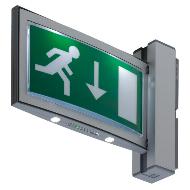
An emergency light is a battery-backed luminaire that automatically switched on when a building has a power outage, which can be cause by mains power failure, a (local) building supply failure or fire. Emergency lighting systems are mandatory in virtually all new commercial, retail and high occupancy residential buildings. Many building codes also require that emergency lighting systems be installed in older such buildings.
When the electrical power fails, for whatever reason, emergency lighting must turn on to provide a minimum amount of light in designated areas to allow building occupants (including - for example - visitors and shoppers) to escape quickly, efficiently and without panic to a place of safety.
A key requirement is that escape routes should be able to be used at all times, including during normal supply failure, so emergency lighting is likely to be needed if the premises are used by anyone outside daylight hours, or at any time if the premises have escape routes without windows providing natural lighting. For this reason, all emergency lighting systems need to be separately powered from the mains system - typically by batteries, emergency generating sets or UPS - and set to turn on immediately the mains electrical power fails.
Basic technologies:
An emergency lighting installation may be a central standby source (e.g. a bank of lead acid batteries and control gear/chargers supplying slave fittings throughout the building).
Alternatively, it can be based upon use of 'self-contained' emergency fittings comprising lamp, battery, charger and control equipment. Self-contained emergency emergency lighting systems operate in two main modes: 'maintained' (which is illuminated continuously), or (illuminated only when the normal power supply fails). Note that 'non-maintained' emergency lighting systems must provide light for a certain set period of time ('autonomy').
Clearly, the cabling from the central power source to emergency luminaires should be segregated from other cabling, and only fire resistant cabling and wiring systems should be used.
Recommendations by codes of practice:
Codes of practice - such as BS 5266-1:2011 'Emergency lighting - Part 1: Code of practice for the emergency escape lighting of premises' 1 - lay down requirements governing the siting of emergency lighting fittings. The aim of BS 5266-1 is to promote wider understanding of the different types of emergency lighting system which may be employed, and to give guidance on their correct application to the varied requirements of different categories of premises.
BS 5266-1:2011 recognises that, in addition to ensuring safe unobstructed means of escape from the premises at all times, an important function of emergency lighting is to make possible the immediate location and operation of fire alarm call points and fire-fighting equipment, and another is to minimise the chance of panic arising in enclosed spaces, such as lifts. BS 5266 specifies that a fitting must be within 2m horizontally from a fire alarm call point or location for fire fighting appliances 2.
Codes of practise also recommend minimum illumination levels in escape routes and open areas.
In another move towards still greater safety, the latest version of BS5266 (BS 5266-1:2011) also requires that 'non-maintained' emergency lighting fittings must be supplied from the same final circuit as the main lighting circuit in the area concerned - this helps protect building occupants from a sudden loss of the normal lighting supply.
BS 5266-1 coverage:
BS 5266-1 covers the following emergency lighting system topics:
- Scope
- Normative references
- Terms and definitions
- Consultation and records
- Illumination for safe movement
- Emergency escape lighting design
- Batteries
- Wiring systems and circuit requirements
- Choice of appropriate emergency lighting systems
- Emergency lighting design procedure
- Certificates and log book
- Servicing.
Compliance:
Under the Fire Safety Order (FSO), which concerns non-domestic premises having employees or guests in England and Wales (Scotland 3 and Northern Ireland have equivalent legislation), Fire Protection Officers (FPOs) can use their powers of enforcement where fire protection and emergency lighting systems have been found wanting. This is now happening, more people are being prosecuted, and sentences are becoming increasingly severe.
The responsible person ('duty holder' in Scotland) has to risk assess premises by checking fire safety equipment. He or she must identify any upgrades required, and must also either obtain third party assurance for fire safety equipment (including emergency lighting), or must demonstrate - possibly in a court of law - that the fire safety equipment is of 'equivalent quality'.
The FSO places considerable responsibility on owners and managers of non-domestic premises to demonstrate that their premises are safe. When a risk assessment shows the need for emergency lighting, such users must be able to demonstrate - via the 'Responsible Person' concerned - that appropriate equipment has been chosen and used to provide adequate light levels. The 'Responsible Person' is someone who has control, or a degree of control, over premises or fire-prevention systems (which includes emergency lighting systems) within premises.
UK legislation imposes a duty on the 'Responsible Person' to carry out risk assessments and to take precautions to ensure 'as far as reasonably practicable' the safety of building occupants. Such precautions include the provision of safe emergency routes and exits, together with, where necessary, suitable exit signs.
The guides to the FSO recommend that emergency lighting should be designed, installed and maintained to the guidance given in British Standard Code of Practice BS 5266-1, which calls for products used to meet their appropriate standards. It is essential, therefore, that responsible building owners and managers can demonstrate compliance with this legislation.
ICEL (www.icel.co.uk) - the leading UK authority on emergency lighting, and the emergency lighting arm of the Lighting Industry Association (LIA - www.thelia.org.uk) - provides suitable expert advice, including how to ensure compliance with the regulations, such as the FSO. ICEL advice (and approval of products and manufacturers in some cases) takes the risk out of specifying emergency lighting and ensures that the lighting performance of the luminaires has been independently confirmed.
Testing requirements:
It is required that every emergency lighting system luminaire be subjected to daily, monthly and annual testing in accordance with EN 50172. This should be conducted at a safe time and without putting people in the premises at risk if a mains failure occurs during a test. Accurate records must be kept of each inspection and test. Maintained luminaires and exit signs must be checked daily, and all self-contained emergency lighting must be functionally tested typically for at least 60 seconds at least every month, and tested for full rated duration of typically three hours at least every year.
BS5266 requires the following:
- A daily visual check on lamp operation in maintained luminaires.
- A daily check on indicators of central battery systems.
- All self-contained emergency lighting must be functionally tested typically for 5 -10 minutes at least every month.
- A full annual full discharge test.
- After three years is up - the annual test must be for the full duration.
- A logbook must be kept up to date with details of the emergency lighting system installed, together with all events and checks.
All test results must be recorded and reported to the building's 'Responsible Person' and any repairs or remedial work identified must be carried out within a reasonable time.
Such testing can be carried out manually, but especially in large, complex buildings, this can be disruptive and very time consuming, so the way around this is to use automatic testing systems (ATS). This is a reliable way of regularly checking that the battery is connected and receiving charge, that the lamp will strike correctly when required and that the battery can run the lamp for the rated duration. Read more about this elsewhere in this VoltiTECH.
Why use ICEL approved products?
ICEL member companies manufacture quality emergency lighting equipment compliant with the safety and performance of the relevant standards. They are also able to provide emergency lighting designs meeting the current legislation and best practice. When installed correctly, they will save lives in an emergency.
And finally…
This VoltiTECH contains a number of articles by ICEL on all aspects of emergency lighting system codes of practise, regulations, specification and operation. Do take a look as they have been provided by the UK's foremost experts on emergency lighting topics and issues. To see these articles, go to:
Specifying certified central emergency lighting power systems is crucial in fully protecting building occupants
www.voltimum.co.uk/news/19377/consult.experts_hottopics.Lighting.Overview/specifying-certified-central-emergency-lighting-power-systems-is-crucial-in-fully-protecting-building-occupants.html
Converting emergency lighting safely using the revised ICEL 1004:2013 registration scheme
www.voltimum.co.uk/news/19379/consult.experts_hottopics.Lighting.Overview/converting-emergency-lighting-safely-using-the-revised-icel-1004-2013-registration-scheme.html
ICEL helps provide emergency lighting installation assurance of competence
www.voltimum.co.uk/news/18806/consult.experts_hottopics.Lighting.Overview/icel-helps-provide-emergency-lighting-installation-assurance-of-competence.html
ICEL explains why and how the Code of Practice for emergency lighting, BS 5266-1, has been revised
www.voltimum.co.uk/news/18566/consult.experts_hottopics.Lighting.Overview/icel-explains-why-and-how-the-code-of-practice-for-emergency-lighting--bs-5266-1--has-been-revised.html
LEDs provide major benefits for emergency lighting luminaires and exit signs
www.voltimum.co.uk/news/17989/consult.experts_hottopics.Lighting.Overview/leds-provide-major-benefits-for-emergency-lighting-luminaires-and-exit-signs--says-icel.html
ICEL assists with the BAFE scheme for emergency lighting installations
www.voltimum.co.uk/news/17964/consult.experts_hottopics.Lighting.Overview/icel-assists-with-the-bafe-scheme-for-emergency-lighting-installations.html
Use of emergency lighting to assist in compliance with building fire safety
www.voltimum.co.uk/news/17965/consult.experts_hottopics.Lighting.Overview/icel---use-of-emergency-lighting-to-assist-in-compliance-with-building-fire-safety.html
ICEL assists in ensuring emergency lighting compliance with the FSO
www.voltimum.co.uk/news/17314/consult.experts_hottopics.Lighting.Overview/icel-assists-in-ensuring-emergency-lighting-compliance-with-the-fso.html
Good emergency lighting scheme design crucial for commercial building safety
www.voltimum.co.uk/news/14953/consult.experts_hottopics.Lighting.Overview/good-emergency-lighting-scheme-design-crucial-for-commercial-building-safety.html
Self-test emergency lighting saves money and increases safety
www.voltimum.co.uk/news/15447/consult.experts_hottopics.Lighting.Overview/self-test-emergency-lighting-saves-money-and-increases-safety.html
Emergency luminaires - the benefits of benchmarking
www.voltimum.co.uk/news/15449/consult.experts_hottopics.Lighting.Overview/emergency-luminaires---the-benefits-of-benchmarking.html
Lamps for emergency lighting applications
www.voltimum.co.uk/news/15440/consult.experts_hottopics.Lighting.Overview/lamps-for-emergency-lighting-applications.html
Emergency lighting testing requirements under BS 5266
www.voltimum.co.uk/news/14837/consult.experts_hottopics.Lighting.Overview/emergency-lighting-testing-requirements-under-bs-5266.html
LEDs provide major benefits for emergency lighting luminaires and exit signs
www.voltimum.co.uk/news/14806/consult.experts_hottopics.Lighting.Overview/leds-provide-major-benefits-for-emergency-lighting-luminaires-and-exit-signs--says-icel.html
Non-compliant emergency lighting products put people and property at risk
www.voltimum.co.uk/news/14462/consult.experts_hottopics.Lighting.Overview/non-compliant-emergency-lighting-products-put-people-and-property-at-risk.html
ICEL shows how LEDs provide major benefits for emergency lighting luminaires and exit signs
www.voltimum.co.uk/news/14463/consult.experts_hottopics.Lighting.Overview/icel-shows-how-leds-provide-major-benefits-for-emergency-lighting-luminaires-and-exit-signs.html
Emergency lighting design guide by Thorn
www.voltimum.co.uk/news/16337/s/Emergency-Lighting-Design-Guide.html
OSRAM talks about emergency lighting types
www.voltimum.co.uk/news/8002/s/OSRAM-talks-about-Emergency-Lighting.html
Notes:
1 BS 5266-1:2011 'Emergency lighting - Part 1: Code of practice for the emergency escape lighting of premises' provides recommendations and guidance on the factors that need to be considered in the design of, and the installation and wiring of, electrical emergency escape lighting systems, in order to provide the lighting performance needed for safe movement of people in the event of the supply to normal lighting failing. It also gives recommendations for lighting in areas with fixed seating. This part of BS 5266 supersedes BS 5266-1:2005 and BS 5266-10:2008, which have been withdrawn.
2 This may change - where there is no emergency lighting (in - for example - areas of 60m2 or smaller) - there will soon be a requirement for 5 lux lighting level on the floor if near a call point.
3 The Fire (Scotland) Act 2005, as amended, introduced changes to fire safety law in Scotland and repealed previous fire safety legislation. Sections 53, 54 and 56 of the Fire (Scotland) Act 2005 place a duty of compliance on employers, employees, managers, owners and others in relation to fire safety.