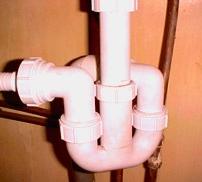
Our Voltimum Experts answer your questions on a daily basis in our Technical Expertise area. This one, concerning an installation with a possible mixture of copper and plastic water services, and bonding arrangements, is answered by SELECT:

There is a main protective bond to the gas, but I cannot see a bond for the water services at the main stop tap. At the main stop tap area there is also copper piping running in close proximity to socket outlets. The client assures me that plastic piping has been used and, to be fair, he did show me a photo to suggest plastic piping has been used, but copper piping is clearly evident at each of the radiators. The bathroom radiator has no supplementary protection (no bond, nor 30mA RCD protection).
Would a main protective bond be needed to be provided at main stop tap? Also, are any through links required to bypass the plastic piping? Is 30mA RCD protection for circuits within the bathroom for this installation.
Are these arrangements to be deemed satisfactory on a Periodic Inspection Report? Or has the original designer omitted the bonds, as he feels that the metallic piping is not an extraneous conductive part?
Answer: As you indicate, it is unlikely that small lengths of copper pipe would be regarded as extraneous conductive parts, so protective bonding would not normally be required.
Supplementary equipotential bonding in the bathrooms would, again, only be required if the radiators (supplied via mainly plastic pipes) could be considered extraneous conductive parts - this is unlikely in this instance. So bonding would not be required. Metal pipes in close proximity to sockets should not be a problem.
To see many more Q & A in Voltimum UK's Experts Area, please click on the link:
www.voltimum.co.uk/consult.php?universe=consult.index.questions