























































Published: 5 February 2015
Category: Technical articles
Chris Ashworth of BIM4M2 explains how this community can help manufacturers in the electrical sector to decide if and how they should be investing in BIM:

BIM4M2 was formed in April 2014 becoming one of the 25 BIM4 communities working to help the industry to make the cultural and technical changes required to adopt BIM. These groups are voluntary and self-funding, reporting through to the government Task Group.
Although the government’s mandate was the catalyst for the adoption of BIM in construction it is now very definitely a cross-industry initiative. This is reflected in the interests represented by the other communities which include Retail and Housing amongst the five Client groups, as well as Fitout, DataCentres, FM, SME and the UK Contractors Group.
One of the early initiatives of BIM4M2 was to conduct a survey of just under 200 product manufacturers, of which 13% were in the electrical supply and lighting sector. This was done to understand how we as a newly formed group could add value to those embarking on that journey.
An important part of our remit is to educate manufacturers and the insights from this research are helping us shape the advice we are developing. Secondly, we want to share the insights from the survey with as many product manufacturers and other interested stakeholders as possible. The survey should help those who have commenced their journey to assess progress and should act as a stimulus for those thinking about embarking shortly.
The education process being developed by BIM4M2
Those surveyed that have invested in BIM (40%) have done so to create commercial advantage (41%); in response to customer demand (27%); or in order to get specified (12%). However, 50% of those surveyed, whilst planning to invest in BIM soon (next 12 months), have yet to make a start. Of those not intending to invest in BIM, the cost was the main barrier (77%), followed by lack of in-house resource (43%).
It is highly likely that some of these respondents are unaware of the Product Data Template route to compliance, which requires no more internal skills than are currently required to deliver project information; just in a different format.
Now is the optimum time to start your BIM journey, because the standards and optional tools will be complete this Spring. So there is increasing clarity on what is required from product manufacturers. Having said that there are still some important choices to be made.
One of those choices is about exactly what you need to develop and whether to do it yourself or get a third party to do the work.
The first stage is to carry out a business audit, and then to determine whether Product Data Templates (PDTs) or BIM objects are the best choice for your company. PDTs are Excel based templates that capture all the product information required by a specifier and are compatible to BIM level 2. BIM objects (with PDT information as a minimum, plus graphical representation of your product) may be preferred by some specifiers.
But whilst populating PDTs can be done in-house (they become Product Data Sheets when you have populated them with your information), fewer companies will have the internal skillset to develop their own BIM Objects.
Our survey found that 38% of us are using external resource to develop our desired solution, but 36% are using internal resource. And the software of choice used is Autodesk Revit (74%) with only a quarter planning to add additional formats.
Flexibility essential
It would be quite easy to become UK centric in our approach to BIM. However, since 52% of those surveyed export to mainland Europe, it is clearly important that all BIM solutions are sufficiently flexible to work in other geographies, with minimal adaptation. Working with BuildingSMART to achieve standards consistency across geographies will become an increasingly important part of the BIM4M2 role.
1 in 4 respondents saw investment as a barrier to adopting BIM. The main concern is the resource required; but almost as important is convincing internal stakeholders as to the importance of focussing on BIM. Developing the business plan rationale to convince senior managers to invest in a BIM solution is part of the advice that BIM4M2 is developing for product manufacturers.
Understanding software options also comes out as a greater concern than obtaining the finance to develop appropriate solutions. Of those that have implemented a solution, 58% consider it to have been a worthwhile investment, with one product supplier commenting –
“There have been a high number of BIM downloads from our website and, as users are willing to register - a good quality database of users is being established. We conducted a survey of those downloading our files and 80% of downloads were for use on current projects. Our specification team are following up on those leads.“
How to make content available
Developing BIM objects is not the end of the journey, we have only reached base camp at this point.
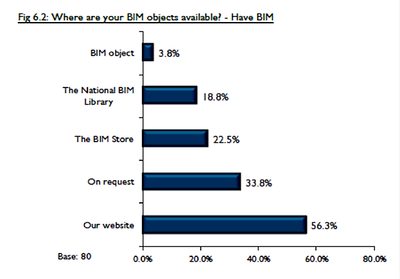
The obvious place to promote your BIM solutions is your website (56%), but 34% of us are being more coy by only making the content available on request. The logic here is perhaps to protect the commercial advantage and tie in a technical conversation to the request, before sharing content.
However, 45% of respondents are making their content available through the libraries or clouds available such as BIMstore, NBL and BimObject. (many of which are hosted both on a library and on a manufacturer website). The libraries give manufacturers an equal presence regardless of size, as well as a high number of specifiers searching their content; something that individual product manufacturer websites can’t always achieve.
Those that have published BIM objects can expect requests from architects on a regular (39%) and an occasional (54%) basis; but fewer contractors make requests, as can be seen below. Making architects, engineers and contractors aware of your BIM capabilities is clearly an important focus area that can increase lead generation and specification opportunities.
Having a BIM solution where your competitors do not, is likely to be a short term differentiator. How successfully you build the new leads you generate into your CRM processes, and make the connection between BIM solutions and projects won, will be one of your long term differentiators.
Only 13% of those that have BIM solutions have case study examples of how BIM has helped secure work. This is probably because it can take several months for projects to come to fruition, and many additional weeks to develop good case studies thereafter.
Another reason might be that the BIM solution has been developed as a piece of content, not as a catalyst for process improvement. If the content has been developed by Marketing or Technical; have Sales been fully engaged?
Of those manufacturers that have BIM solutions, 82% have an individual responsible for BIM in their organisation, whereas for those planning BIM it is still a positive 58%. The benefits of BIM to the manufacturer are not just external. The need to provide up-to-date structured data in a digital format can lead manufacturers to improve internal processes.
Further BIM possibilities
Can the data provision be automated? Can the data be used in the manufacturing process?
There are examples starting to emerge, anecdotal at present; where companies have used BIM to improve internal processes in a number of ways. To the question : why did you invest in BIM? 'Business process efficiency', and 'Improved efficiency of manufacturing workflow' support the idea that BIM is as much about internal process improvement as it is about winning or maintaining specifications.
There is still an education job to do, even amongst those that have already published their BIM solutions. 59% of respondents incorrectly think that BIM Objects must be supplied to meet the Governments requirements in 2016. In fact it is just structured data to PAS 1192 – 2:2013 that needs to be supplied. The PDTs are sufficient for this, but only 38% of us are aware of their existence.
In summary, the health-check on product manufacturers from this survey is that many (40%) are ready for April 2016 and most of the rest (50%) intend to be. However, there is still some knowledge building required even amongst those that have launched their own BIM content.
To learn more about BIM4M2 go to www.bim4m2.co.uk or download the full report at: http://bim4m2.co.uk/wp-content/uploads/2015/02/BIM4M2-BIM-Adoption-by-Product-Manufacturers_03Feb.pdf
Chris Ashworth is BIM4M2 Promotions Working Group Chair and Director of Competitive Advantage Consultancy, which conducted the survey.
See more from Voltimum on Google
Add Voltimum as a preferred source and Google will show our articles more often in your news results.