
NICEIC takes you step by step through the procedures and requirements for electrical installations.

Working at height
Slips, trips and falls are, by far, the most common cause of injury in the workplace and particularly for those NICEIC contractors working at higher levels, for example installing PV systems on roofs, the consequences of falls can be fatal. Aimed at reducing the number of injuries and fatalities from falls in the workplace, The Work at Height Regulations 2005 (WAHR) place a duty on employers, the self-employed and any persons that control the work of others, such as facilities managers or building owners (commonly referred to as dutyholders), to assess the risks, plan and supervise all workers who work at height.
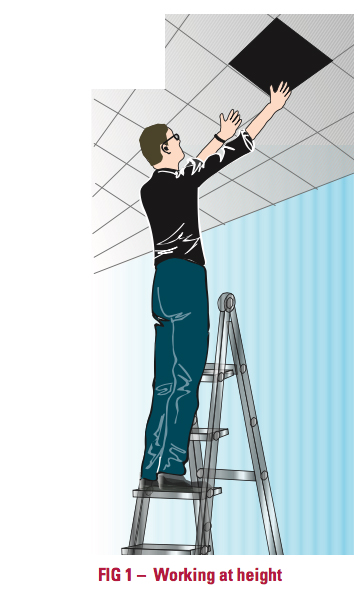
A workplace is considered to be ‘at height’ if a person could be injured by falling from it, even if it is below ground level. This will include working on step- ups, ladders, step-ladders, scaffolding and the like.
Role of employer
Regulation 6(3) of WAHR requires that a dutyholder must do all that is reasonably practicable to prevent anyone from falling. Dutyholders are required to ensure that all work at height is properly planned and organised so that:
- no work is done at height if it is safe and reasonably practicable to do it other than at height
- work is properly planned, appropriately supervised, and carried out in as safe a way as is reasonably practicable
- there is a plan for emergencies and rescue
- account is taken of an appropriate risk assessment carried out under regulation 3 of the Management of Health and Safety at Work Regulations 1999.
Role of the employee
Regulation 14 requires an employee or a person working under someone else’s control to:
- report any safety hazard
- use the equipment supplied properly (including safety devices)
- follow any instructions and training (unless they think that would be unsafe, in which case further instructions should be sought before continuing).
Working area and access
- is stable and of sufficient strength and rigidity for the purpose for which it is intended
- rests on a stable and sufficiently strong surface
- is so constructed and used, and maintained in such condition, as to prevent, so far as is reasonably practicable, the risk of slipping or tripping.
Requirements for ladders
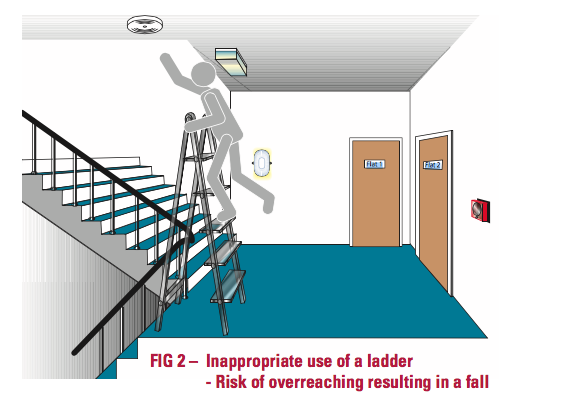
Schedule 6 in WAHR details the requirements for ladders, and reinforces that ladders should be used only after a suitable risk assessment has been carried out and it can be demonstrated that the use of more suitable means of access is not justified.
Table 1 provides examples of the details contained in Schedule 6.
| Surface | Stable, firm and of sufficient strength and suitable composition safely to support the ladder in such a way that the rungs or steps remain horizontal. Ladders should not be erected on a lean. |
| Position | In such a way that it is stable during use. |
| Suspended ladder | Attached in a secure manner so that it cannot be displaced. |
| Portable ladder | Stiles secured at either their upper or lower ends. An effective anti-slip or other effective stability device , or any other arrangement of equivalent effectiveness. |
| Long enough | Shall be long enough to protrude sufficiently above the place of landing to which it provides access, unless other measures have been taken to ensure a firm handhold. |
| Interlocking ladders | Not to be used unless sections are prevented from moving relative to each other during use. |
| Mobile ladder | Prevented from moving before it is stepped on. |
| Ladders rising 9m or more | Where practicable, suitable landing places are provided to provide rest points. |
| During use | Can maintain a hold when carrying a load unless, in the case of a stepladder, the maintenance of a handhold is not practicable when a load is carried, and a risk assessment has demonstrated that the use of a stepladder is justified because of the low risk and the short duration of use. |
Table 1 – Examples of the requirements of Schedule 6 of WAHR
Inspection
Generally, safety equipment, such as ladders and platforms, should be inspected prior to their installation and after they have been installed.
Regulation 12(7) requires that a person carrying out an inspection of work equipment shall prepare a report containing the particulars set out in Schedule 7, and within 24 hours of completing the inspection, provide the report or a copy thereof to the person on whose behalf the inspection was carried out. The particulars to be included are:
- the name and address of the person for whom the inspection was carried out
- the location of the work equipment inspected
- a description of the work equipment inspected
- the date and time of inspection
- details of any matter identified that could give rise to the health or safety of any person
- details of any action taken as a result of any matter identified
- details of any further action considered necessary
- the name and position of the person making the report.
For training on ladder safety go to http://www.niceic.com/training/online-blended/ladders
The Work at Height Regulations 2005 may be downloaded from www.legislation.gov.uk/uksi/2005/ 735/contents/made
For information about the NICEIC Approved Contractor or Domestic Installers schemes visit www.niceic.com or call 0870 013 0382