
























Sustainable power technologies, such as solar photovoltaic (PV) panels, are becoming increasingly common. This is being driven by energy saving needs and climate change legislation. Voltimum UK managing editor James Hunt looks in this article at the associated installation equipment:

Note at the outset that solar and wind power can be combined to form hybrid system, though installation will be a little more complex. Whichever type is selected, it has to be carefully fitted out with suitable electrical and other equipment to function optimally. What is required?
Firstly, a safety reminder - solar PV panels produce electricity all the time they are exposed to light, so working with them can be hazardous. Also, solar PV modules are designed to have working lives of 20 - 25 year, so some components will have to work reliably outdoors for this period, unaffected by extremes of weather and even attacks by rodents.
Typically, a domestic solar PV kit for smaller homes includes 0.5 -1kW solar modules, suitable mounting frames for roof or ground, DC circuit breaker, a 45A solar regulator, a 1500W pure sine wave inverter, a 700Ah 12VDC battery bank, plus all cables and connectors. The kits for larger homes and other buildings are broadly similar, but require larger powers. Other domestic solar PV equipment can include special cabinets for network feed-ins, and active switches for communication and monitoring.
For example, Phoenix Contact (www.phoenixcontact.co.uk) supplies a 24 V / 200 Wp solar system for worldwide use. It comprises a solar panel, pre-wired control cabinet with charge controller, solar battery, fuses, surge protection and installation assembly materials (including mast clips).
Mounting the solar PV panels:
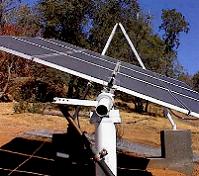
As stated, solar PV panels can be ground, roof- or mast-mounted, though for most homes, roof mounted systems are the commonest type. However, there are simplified types available that can be placed almost anywhere using fold out legs. In the UK, solar PV arrays should be south facing, angled at 30 degrees.
In terms of the fittings, the solar PV modules have rigid shells that can be bolted or clamped to roofs using roof anchors. Roof mounting frames are provided by Unirac and Ubbink (Renusol), but there are many others.
However, to obtain optimum solar performance, the time solar arrays face the available sun must be maximised using solar trackers. This, of course, adds to cost and complexity, so calculations have to be made of performance improvement against extra cost to decide viability. Bear in mind that controlled tracking systems can provide up to 40% more efficiency than fixed solar layouts. A good example of a solar tracker is the DEGERtraker 3000NT/ 5000NT / 7000NT range, which comprises dual-axis active tracking systems for free-standing solar PV applications.
Power conversion:
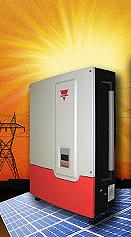
You have fitted the solar PV panels, and they work, but how to handle the resulting power? A suitable inverter must be fitted. This converts the PV array's DC output to AC, which is essential for 'off-grid' applications with power supplied from charged-up batteries. If the system is 'grid-tied', it can export any excess electricity into the grid. At night, power is imported back.
Anti-islanding safety circuits and interface protection integral with the latest solar PV inverters ensure that power is only produced when the unit is connected to the grid, which is active and operating within National standards.
ABB's (www.abb.com) first solar inverter, the 100 - 500kW PVS800, has been designed for industrial-scale PV power plants and for medium-sized power plants installed on the roofs of commercial or industrial buildings. Miniaturisation is important in homes, as the inverters are usually installed indoors. Soladin 600 mini string inverters, available from Mastervolt, were claimed to be world's smallest, though Mitsubishi Electric's PV Series intelligent power modules may be smaller at just 90mm × 50mm. Other inverter suppliers and manufacturers include Carlo Gavazzi, Genius, Cotek, Victron, Outback and Studer Innotec.
Inverter-chargers combine inverter and battery charger in one unit, and can act as an uninterruptible power supply (UPS). Pulse width modulation (PWM) controllers in 12, 24 or 48V (to 4kW) ratings provide reliable solar battery charging and load control, or can divert excess power to a dump load. Suppliers include Outback, Studer, Steca and Victron.
Connection and cabling:
Solar PV panels (modules) are usually supplied factory pre-wired for easy connection. Cables, for delivering electricity to consumer unit/meter, are sometimes supplied with reverse feed blocking diode, plus suitable connectors. They should be double insulated, weatherproof and rodent-proof.
Cable types range from photovoltaic LV cables for linking PV panels to copper / aluminum cables carrying energy from array boxes to inverters, to special halogen-free cables for secure rooftop installations, silicone cables for cold environments, and earth cables to guard against short-circuits. Copper and fiber-optic cables can be provided for surveillance and control include sensor and bus cables (for tracking systems).
When installing cable, it should be laid in parallel with looping avoided (except where entering a building), and should always follow the shortest possible route to array combiner boxes - Eaton (www.eaton.com) is one company that manufactures combiner boxes for solar power installations. For parallel connections, branch connectors will be required. All outdoor connectors should have a suitable IP rating for long-term exterior use.
Always check for polarity, and that the sum of the open circuit voltages of all solar PV modules in the string equals the string's open circuit voltage. All DC cable should be clearly identified. Important - don't lay cables near lightning conductors.
Nexans (www.nexans.co.uk) is one company that manufactures a range of cables suitable for solar PV installations. However, rather than just providing cables and components, Nexans' KEYLIOS solutions can outfit a complete solar installation, assuring that all elements are fully interoperable and compatible. The company says that its contribution to solar PV applications is through 'high-end, quality products that result in long-term performance, surveillance, monitoring and remote control, operational security and fire safety'. Draka (www.drakauk.com) also manufactures many advanced cables, some of which may be suitable for solar PV installations. Other manufacturers of solar PV cable include Amphenol and Helukabel (supplied by Daetwyler in the UK).
A waterproof junction box assembly will be required. The latest types may contain bypass diode connections, a moisture protection filter and PV cable terminals. In installation, junction boxes are designed to be simply placed on to the base already fitted to the PV module(s).
Cabinets, plus circuit & equipment protection:
PV array currents need to be isolated, protected and switched. Cabinets fitted with fuses and switches may be required. Larger cabinets located away from homes allow the utility concerned to isolate the network, either from a consumer or producer perspective. These cabinets form a major node between private and public networks and a security point for maintenance.
In terms of circuit protection, Eaton's Moeller offers a comprehensive range, including DC switch-disconnectors from 20-63A. The enclosed SOL model is ideal for outdoor use. The Moeller 12-63A DC string circuit breakers protect PV modules from fault currents. Fuses can also be used for protection. Go to www.moeller.co.uk
Batteries, charging and regulation:
Batteries are used to store the solar PV generated electricity until needed for use. Modern batteries provide long life for solar energy storage, and maintenance-free sealed lead acid batteries are probably best for the application. A good example is Elecsol's carbon-fibre gel Solar battery, which has a seven-year unconditional warranty. Other solar power battery suppliers include Victron and Sonnenschein. Battery monitors and isolators are a good idea.
A voltage regulator/charge controller keeps batteries charged and avoids overcharging or deep discharge damage. Such controllers vary from simple types to sophisticated PWM versions. To choose a suitable one, use the familiar amps = watts ( volts equation, so that - for example - an 80W solar PV array charging a 12V battery should be regulated using a 6.7A solar regulator (80W/12V = 6.7A).
The Feed-In Tariff and smart meters:
For householders wishing to export excess electrical power back to the grid, the Feed-In Tariff for micro-generation electricity (now implemented) means that they should be paid 41.3p /kWh / unit exported (less for larger systems). This is on top of the Generation Tariff.
For micro-generation electricity to be successful, it will be essential for the latest 'smart meters' to be installed. These allow the monitoring of energy being consumed and fed-in to the grid. Smart meters work like this: they calculate electricity units consumed, plus the amount exported. This data is sent to the supplier for monitoring and billing through connection with the homeowner's consumer unit, or wirelessly transmitted to a receiver station up to 100m away using radio telemeters (RTM). Smart meter technologies include real-time sensors, power outage notification, power quality monitoring and automated meter reading (AMR). Their use will speed micro-generation growth.
Companies that are involved with electricity metering and smart metering, plus related equipment, include ABB (www.abb.com), Eaton (www.eaton.com), Horstmann Controls (www.horstmann.co.uk), Schneider Electric (www.schneider-electric.co.uk), British Gas, GE, Echelon, Itron and Landis+Gyr. Contact Ofgem (www.ofgem.gov.uk) for more information.