By: James Eade

From January 2019 every event will need to be compliant with BS 7671:2018; having pre-built equipment that you can easily re-use is fine, until it needs changing.
So what changes are likely to affect the industry? The IET asked some of the Association of British Theatre Technicians (ABTT) companies for comment on the 18th Edition, and how it might affect their businesses.
Chapter 41
Chapter 41, which covers protection for electric shock, sees quite a few changes. Currently Table 41.1 requires circuits under 32 A to have a disconnection time of 0.4 seconds, whereas this is being increased to 63 A going forwards.
This is not a problem if you use miniature circuit breakers for protection, as the operating time is the same between 0.1 and 5 seconds. However, as Mark White, EU Sales Manager for the international stage lighting manufacturer ETC notes: “Many theatres still have legacy equipment with re-wireable fuses in them; they won’t pass muster anymore. It could have financial implications for some.”
Regulation 411.3.3
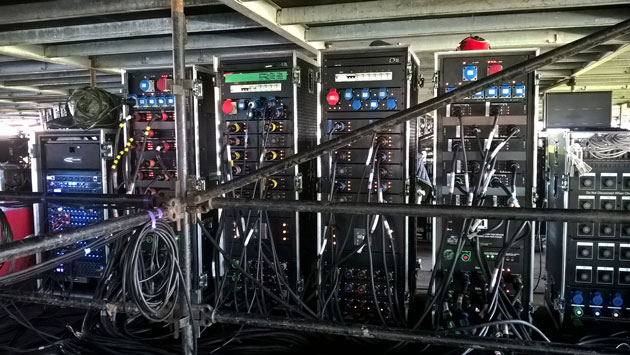
Regulation 411.3.3 requires the use of 30 mA RCDs to provide additional protection against the risk of electric shock. It has been revised and now applies to socket-outlets with a rated current not exceeding 32 A indoors. In events, both single and three-phase 32 A circuits are often used for distribution, powering other units with appropriate RCD protection on final circuits.
There is of course the problem of ensuring appropriate selectivity (formerly referred to as ‘discrimination’) between devices, and ensuring that unwanted operation of RCDs does not occur given the normal leakage currents from equipment.
Richard Bunn, Senior Consultant for Venues with Consultancy Arup, Bunn says: “The rise of LED based luminaires with smaller loads and deliberate leakage currents associated with EMC filtering is presenting a significant challenge for distribution strategies. The limiting factor on the number of luminaires that may be connected to a circuit has once again become avoidance of unwanted tripping of the RCD rather than total load on the circuit. This will impact the design of new connection panels for temporary equipment.”
AFDDs
For the first time in a while, a new type of protective device makes a debut in this Edition - the Arc Fault Disconnection Device (AFDD). These devices can identify arcing in a circuit and will provide protection for insidious faults like cable damage or equipment failure where there may not be enough current flowing to operate other protection such as circuit breakers, but enough to start a fire.
Currently they are recommended in final circuits where there’s a heightened risk of fire or the effects thereof i.e. sleeping accommodation, locations storing flammable substances or installations at risk of fire such as old wooden buildings for example. This is where they could come in particularly useful; many old theatres are full of old timbers in stages and roof structures for example. They usually contain lots of old wiring and equipment too – as such retrofitting AFDDs could provide significant benefits.
Regulation 521.10.202
Another change is the need to protect cables against premature collapse in the event of a fire. Regulation 521.10.202 has been updated and now requires cables to be adequately supported against their premature collapse in the event of a fire. This now applies throughout the installation and not just in escape routes.
SPDs
Surge Protection Devices (SPDs) are not a new introduction to BS 7671, but the relevant Section in BS 7671 has been substantially revised. That requirement has now changed and protection against transient overvoltages has to be provided where the consequence caused by overvoltage (Regulation 443.4):
(a) Results in serious injury to, or loss of, human life, or
(b) Results in interruption of public services/or damage to and cultural heritage, or
(c) Results in interruption of commercial or industrial activity, or
(d) Affects a large number of co-located individuals.
To read the full article, please visit Wiring Matters.