Bearing in mind that, in a typical UK house, heating system energy consumption can be reduced by up to 40% through the installation of a room thermostat and TRVs, and that installation costs can often pay back within a year, Horstmann Marketing Manager Tim Acton explains how a simple controls upgrade could save millions of UK household’s money on their energy bill.

The controls industry trade body, TACMA, believes that there is a real need for a UK target to ensure that all homes with boilers have a controls package that contains at least a programmer, room thermostat and thermostatic radiator valves (TRVs).
You’d expect me to endorse these objectives (and I do) but what is not always apparent is just how simple an upgrade can be, and how quickly the householder ‘pay back’ can be achieved.
TACMA’s target is endorsed by latest research which shows that the installation of effective temperature controls on home heating systems has a far more significant effect on minimising energy use than previously predicted. Tests in a typical UK house reveal that energy consumption by the heating systems can be reduced by up to 40% through the installation of a room thermostat and TRVs, with installation costs recovered in a year or less.
Controls upgrade makes economic sense:
In itself, a controls upgrade is an economic, cost-effective measure, but it can also have wider benefits. Good use of controls also ensures that energy savings from other measures are fully realised. For example, the room thermostat and thermostatic radiator valve combination will also ensure that the application of insulation does not simply result in excessive internal temperatures rather than lower fuel bills.
Understandably, many householders operating with what we in the industry regard as an ‘inadequate’ controls package might be surprised. They might also balk at the installation cost and the disruption to the house and décor if the installer starts talking about channelling, hard wiring etc. The chances are that the combination of cost and disruption would result in ‘let’s leave it as it is’.
The reality of course is quite different and the installers counter argument is first backed by statistics and figures that TACMA endorses and also by the installer recommending a wireless controls upgrade.
Inefficient:
Work carried out by TACMA with the Energy Saving Trust has identified that about eight million UK homes with a boiler don’t have a room thermostat, and over 70% don’t reach the minimum levels of control.
Many of the eight million homes identified are combi boiler installations using a time switch and TRVs on radiators to provide control - in reality, this is an inefficient solution usually resulting in excessive and wasteful boiler cycling.
But, by introducing a wireless package - a time switch working in combination with a room thermostat (or a programmable thermostat) and with TRVs fitted – TACMA’s 40% energy cost reduction becomes achievable, and importantly, the upgrade is easy to install and programme without needing any hard wiring.
An ideal upgrade would feature a wireless time switch such as the Horstmann CentaurPlus ZW time switch working in combination with a wireless room thermostat – say an HRT4-ZW.
Both units use wireless Z-Wave technology ensuring pairing is simple and reliable with the thermostat operating with the latest sophisticated TPI energy saving software. TPI (Time Proportional Integral) produces enhanced control of temperature settings and a boiler cycling regime that is both energy saving and efficient.
Options:
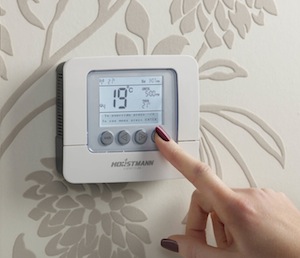
Another option is to install a wireless electronic programmable room thermostat, which offers time and temperature control from a single wall mounted control. Horstmann’s latest model has a new design that includes the latest electronics and TPI software. Again using Z-Wave, in an upgrade or retrofit situation, the wireless version has the advantage of eliminating any channelling or damage to decor, making it a quick and easy changeover.
To achieve the energy savings, TPI software makes a series of calculations that will precisely dictate the amount of heat needed every 10 minutes for gas boilers (20 minutes for oil boilers) and switch the boiler on for a proportion of that time to maintain the set room temperature. This stops the wide fluctuations that can occur with conventional thermostats, and also fine-tunes the demand on the boiler creating the opportunity to save on fuel.
Payback time:
And what of the payback?
Recent Department of Energy and Climate figures indicate that in 2012 the average household energy bill (electricity and gas) was about £1280.
An upgrade as detailed – wireless time switch and thermostat – will require professional installation (in accordance with the latest IEE Wiring Regulations) as the receiver needs wiring into the boiler control. That said, the installation - controls package with a couple of hours of labour - should not exceed £300.
So on the 2012 energy figures, the pay back on the upgrade will be comfortable achieved in a year, not forgetting that when the boiler is eventually replaced, the controls upgrade work will already have been done and won’t need to be done again. It will therefore reduce the cost of the boiler replacement and could actually bring forward that replacement and the resulting energy savings.
The energy and cost benefits from improved controls can be achieved straight away with any boiler. In fact, the percentage improvement from controls added to an older, less efficient boiler will result in a greater total energy saving than with a modern boiler.
The direct savings potential from improvements to controls can also reduce the carbon emissions from heating and hot water by up to 20%. This equates to a potential UK carbon saving of 1.3 MtC (million tonnes carbon), which is greater than the identified potential for loft insulation.
Behavioural changes are important too:
TACMA believes that controls enable people to make behavioural changes to further reduce their energy use. The greatest potential for behavioural savings are in heating and hot water yet, as a simple example, you can’t turn your room thermostat down if you don’t have a room thermostat.
This opportunity has yet to be fully grasped. On current replacement rates waiting for controls to be installed when boilers are replaced is likely to take over 20 years.
It is a significant investment for the householder, so accelerating the rate is likely to prove difficult unless we have another government backed ‘boiler scrappage’ scheme.
A low cost controls upgrade is a much easier decision to influence, and is a much quicker path to achieve cost savings and significant reductions in the carbon emissions from existing homes.