

























-Promo-graphics-(2).png?width=1280)
-Promo-graphics-(1).png?width=800)

Part P competent persons schemes registration for England and Wales. Due to the increased use of home workers using facilities at home it is sometimes required to have remote buildings installed to use as workshops or offices or extensions built onto existing properties.

This article discusses the installation of a distribution circuit used to supply a remote electrical installation from a domestic installation and, to a shorter extent, the implications of extending existing circuits in those instances where an extension is built to an existing property.
Assessment of existing electrical installation
Prior to carrying out any alteration or addition to an existing electrical installation it is essential to ensure that switchgear, earthing, bonding and distribution equipment is of adequate size and rating for the additional rating of an increased load (Regulation 132.16). The designer should assess the current demand of the load allowing for diversity, and determine the voltage drop for the size, type and installation method of the cable chosen.
Installation methods
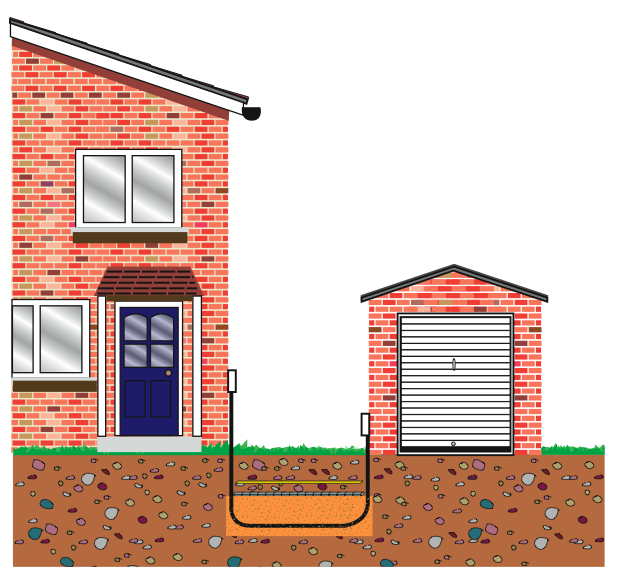
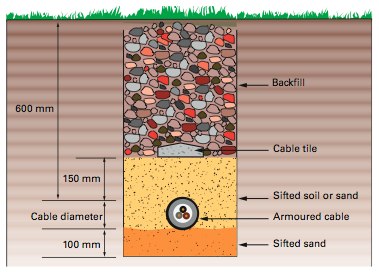
A designer can choose from a wide range of installation methods when running a distribution circuit to a remote building. However, to provide adequate mechanical protection, the method most commonly used is to bury steel wired armour (swa) cable. This type of cable has the advantage of having inbuilt mechanical protection and as such requires no additional means of protection. A swa cable needs to be buried at a sufficient depth to avoid damage due to disturbance of the ground (Regulation 522.8.10). Whilst BS 7671 does not state a minimum depth, the generally recognised depth of a buried cable to prevent disturbance is 600 mm. The cable needs to be surrounded by sharp sand to avoid damage to the sheath by stones or rubble. Above the layer of sand, electrical warning tape should be used to indicate a cable is installed below. Alternatively, the cable could be installed in a pipe which would make rewiring a simpler process. If a pipe were to be used however, care must be taken to ensure that cable in the pipe would not be subject to vermin or water penetration.
Earthing and bonding
The armouring of a swa cable may be utilised as a circuit protective conductor (cpc) if it complies with Table 54.7 in BS 7671 or the adiabatic equation in Regulation 543.1.3. However, it is often the case that PME conditions are present; if this is the case the swa will probably not have adequate cross-sectional-area (csa) for the bonding requirements. One possible option available under such circumstances is to run a separate bonding conductor sized according to Table 54.8. Alternatively, the PME earth may be terminated into a non-conductive box and a TT system can be utilised. This removes the requirement for bonding from the origin at the main incoming supply. Any bonding can be carried out from the TT earth at the remote location if required.
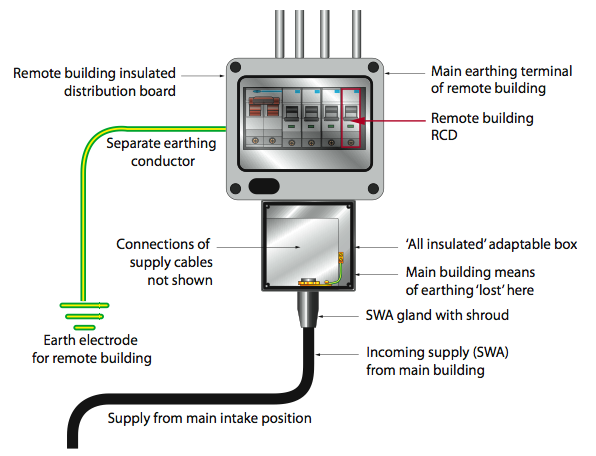
When using a TT earthing arrangement a suitable earth electrode is placed in the ground outside the dwelling. It is important that the resistance is kept as low as possible as ground conditions, due to drying and freezing, can alter and affect the value. A note attached to Table 41.5 in BS 7671 states that a value of below 200 Ω is recommended as the arrangement can become unstable if this value is exceeded. There are various types of earth electrode that may be utilised as stated in Regulation 544.2.3. However, a water pipe or gas pipe should not be used (Regulation 542.2.6) unless precautions are taken to prevent its removal.
Distribution circuit within the dwelling/property
Where an extension is built onto the side of a dwelling, it may not be necessary to run a distribution circuit to a second consumer unit, rather it would be reasonable merely to extend the circuits that currently exist in the property. Any additions or alterations to an installation should comply with the current wiring regulations. Therefore, where an existing installation may have been installed to a previous standard, any new work must comply with the current standard. Where this is the case it will, in all likelihood, be necessary to provide additional protection using an RCD having a rated residual operating current not exceeding 30 mA for the circuits supplying the extension. This may have implications for the equipment supplied from the existing circuit. It may also be necessary to upgrade any existing earthing and bonding cables to ensure they comply with the updated standard.
Inspection and testing
When the installation is complete, it is important that before the installation is energised and put into service that it is fully inspected and tested to comply with Regulation 610.1. Where any new circuit is added, there will be a need to issue an Electrical Installation Certificate and the associated Schedules of Test Results and Inspection. Where there are a series of extensions to circuits the installer may choose to issue either a series of Minor Electrical Installation Works Certificates, where necessary, or a single Electrical Installation Certificate.
Building regulations
For England and Wales, any new circuits connected to a consumer unit require to be notified to the Local Authority Building Control to comply with Part P of the Building Regulations.
- Further guidance can be found in NICEIC/ELECSA Publications which have been updated to the 3rd Amendment of BS 7671.
- For other guidance and publications please see the ELECSA website. Information about the ELECSA Domestic Installers schemes, visit www.elecsa.co.uk or call 0333 321 8220.
See more from Voltimum on Google
Add Voltimum as a preferred source and Google will show our articles more often in your news results.