.svg)
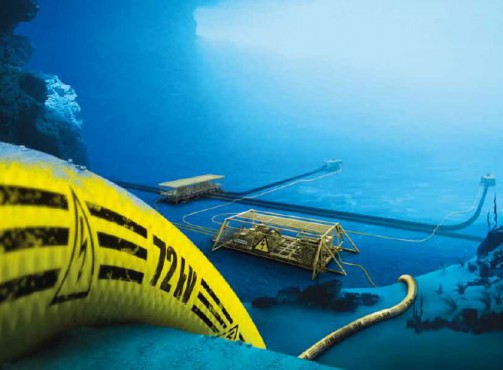
Soon, deep-water oil and gas production facilities will be powered with electricity from their own sea floor supply networks. Sector operators, who are going deeper and who need to cut costs, will increasingly need sub-sea power grids. Siemens has come up with a very special capacitor as part of the planned new network. By James Hunt:

A Siemens Energy Management employee, Ove Bø (60), who works for the company in Trondheim, Norway, has developed a product that will help enable the holy grail of a successful deep-sea electrical power grid to power offshore infrastructures, such as oil and gas. This product is a specialised capacitor that can withstand the massive water pressures encountered at such depths.
Dependable power supply and distribution is vital for subsea production facilities. The deep-water subsea market is still growing significantly, with West Africa, North America, and Europe investing most. This has created a significant market for power grids in subsea and power supply equipment. The trend makes the subsea power grid system industry lucrative, and because of the heavy offshore infrastructure development and the changing focus towards renewable energy sources, the market for such systems is likely to see a big increase in demand.
To date, subsea processing has been powered by fixed platforms, but operators are looking to lower the costs associated with manned facilities while exploring deeper fields. This is why deep-water power grid are becoming necessary, and is the reason why Siemens has been planning to bring to market the first complete electrical power solution for subsea factories by June 2016. It will be called the ‘Subsea Power Grid’.
Siemens’ Subsea Power Grid Qualification Program is, therefore, attracting great interest around the world. Currently undergoing the detail design and test phase, it is a complete medium-voltage power supply and distribution system installed on the seabed.
It incorporates proven high-quality Siemens industrial components, including subsea transformer, switchgear and variable speed drives, as well as a comprehensive power control and communication system. It aims to be the first at water depths down to 3,000 meters at long step-outs from the host, and will be one of the key enablers for large-scale subsea processing.
Filled with oil to equalise pressure
A crucial part of this is the new capacitor. The problem with conventional electrical components – like capacitors – is that they have to operate under enormous pressure at the bottom of the sea; pressures that would normally crush them or at least stop them working.
So Siemens Energy Management in Trondheim have used oil to replace the air that usually surrounds individual electrical components such as transistors, capacitors and other electronic parts in their housings.
This allows pressure equalisation inside the component housings with the pressure in the surrounding seawater, which can rise to 300 bar at depths of 3,000 meters below sea level. This pressure equalisation allows the use of lightweight, thin-walled housings, since the differential pressure across the walls of such housings is almost zero.
‘Marinisation’, testing and patents
Ove Bø, who has worked for Siemens since 1981, developed the original idea, which Siemens then had patented almost ten years ago.
His labours are now starting to bear fruit. Since 2010, engineers have been working flat out to develop the Subsea Power Grid. Prototypes of the deep-sea transformer, frequency converter, drive and switchgear have been mounted on a platform and are reported to be being tested on the ocean floor – or very soon will be.
Bø, who was involved in the development of these subsea components from the start, is eagerly awaiting prototype testing, too. Since 1981, his task has been to hone and refine electrical components. He enjoys tackling technical problems in electricity and marinisation, which means the development of components that are capable of operating in the harsh subsea environment for 20 years or more.
Siemens says that Ove Bø’s creativity and innovation have allowed him make and contribute to 31 inventions that were registered and have led to 31 patent families.
For more information, go to: www.siemens.com/innovation