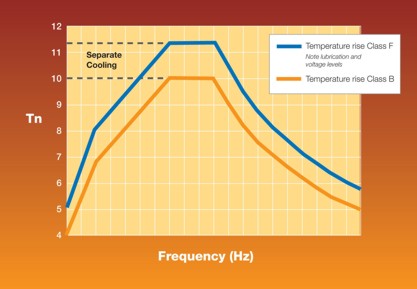
Variable speed drives bring great advantages in controlling motors but care needs to be taken to match the characteristics of the drive to the motor to ensure that the combination is a winning one. For hazardous areas, certain specific aspects need to be born in mind:

To minimise the risk that the selected motor will fail, users need to understand the required operating and environmental characteristics of the application. Motors have to cope with all sorts of environments, from high ambient temperatures, to being immersed in sewage, to operating in dust or gas hazards.
Special designs exist for all of these cases and the user must ensure he follows the motor manufacturer's instructions. Getting all the help you can from motor and drive manufacturers is also a good idea in general; their experience with motors and drives will help find the most compatible motor and drive combination. Many, like ABB for instance, will have local service representatives that can help set up the drive. Users installing their own drives need to read up about the issues that exist when connecting AC motors and drives.
Many variables have to be considered when choosing motors and drive combinations, including voltage ratings, which must be chosen to match line voltages, maximum practical cable lengths, du/dt filters will be necessary, transient voltage surge issues, carrier frequency levels, winding insulation performance, partial load efficiency levels, the number of poles required, speed and torque profile matching, and much more besides, such as insulated bearings, which may need to be considered for certain applications.
For hazardous area use:
Of particular cause for concern is the use of variable speed drives to power motors in hazardous areas. The main sources of risk are high surface temperature and sparks in either the winding or the bearings. This can result in increased temperature rises and higher voltage stresses on the motor insulation. These increase when self-cooled motors are used, as the speed of the cooling fan is reduced along with the motor speed.
These factors can combine to create a source powerful enough to ignite an explosion. The best way to reduce this risk is to choose a combined ATEX package, which gives end users the assurance that the motor and drive combination is optimised for their application.
Note that the application of a drive with an existing, pre-ATEX motor is at the owners risk, and possible only in a Zone 2 area. In any case the certification is the responsibility of the motor manufacturer.
This practice of supplying matched drive and motor pairs is a growing trend and one that progressive vendors have adopted to help cut users' workload to a minimum.
Although not directly a hazardous area issue, it is important to note that the object of a drive is to reduce the speed of a centrifugal fan or pump. The time spent running at full load will therefore normally be limited to emergency situations, such as extracting smoke in the event of a fire.
The picture shows - Variable speed drives bring great advantages in controlling motors but care needs to be taken to match the characteristics of the drive to the motor to ensure the combination is a winning one.