Should users opt for fuses or circuit breakers to protect their equipment from electrical faults? ABB's Janet Roadway says that people need to understand the behaviour of different devices in order to pick the optimum solution for their situation:

Fuses:
Fuses and their associated switchfuses are cheaper than circuit breakers up to a capacity of around 400A. Fuses are also interchangeable with switches from different manufacturers, which keeps the cost of stocking spares down.
The inherent simplicity of fuses is both an advantage and a disadvantage. On the one hand, it makes discrimination and selectivity simple to achieve: if a user wants to protect against a particular current at a particular point in the distribution system, they simply buy and fit the right element.
On the other hand, the fact that they can't be precisely adjusted to match current requirements means that users may instead end up having to specify oversized cables to match the current rating of the fuse. If you need to ensure that your protection device will pass a current for which you can't get a matching fuse, you'll have to specify a larger, rather than a smaller, fuse in order to prevent unnecessary trips. But this means that the capacity of the associated cables will have to be large enough to match the capacity of the fuse otherwise they may suffer chronic deterioration from carrying an overcurrent. If this means using larger cables than would otherwise be necessary, it can make fuses an expensive option.
Fuses also provide only single-shot protection. Once the element has blown it must be replaced and that requires manual intervention, which may have knock-on effects on maintenance costs. And if anyone is tempted by a frequently blowing fuse to replace it with a higher-rated version or even a piece of copper wire, it's relatively easy for them to severely compromise the protection.
Finally, fuses lack any intelligence, so they offer only simple on/off protection and give engineers almost no help in trying to track down the cause of an ongoing fault. The only diagnostic data they can provide is whether or not they've blown.
Thermomagnetic protection:
Thermomagnetic circuit breakers adopt a dual approach to protection. A bimetallic strip offers thermal protection against an overcurrent. For short circuits a coil offers magnetic protection by generating a magnetic field instantaneously as the current appears. This field activates a trip bar which trips the switch.
These circuit breakers are easier to automate than fuses and offer multi-shot protection. Both these features can reduce the cost of the manpower needed to take care of them. Replacing the protection element is more expensive in the case of circuit breakers, however, because it is the actual switch contacts that break the circuit, rather than a separate fuse. But at least the increased complexity of circuit breakers means that 'the copper wire trick' can't easily be used to compromise the protection that they provide.
Circuit breakers can also be adjustable, so they enable users to optimise the size of the associated cables more precisely. On the downside, their added flexibility makes it more complex to set up reliable discrimination with circuit breakers than with fuses. Like fuses, thermomagnetic circuit breakers lack any intelligence and can only offer information about whether they're on, off or tripped.
But the most fundamental disadvantage of circuit breakers compared to fuses is that they cannot match the level of energy limitation of a fuse. Energy limitation, which gives reduced peak currents during short circuit clearance, also limits the damage seen downstream of the protection device.
Electronic relays and circuit breakers:
Electronic relays and circuit breakers use either an external or integral, programmable electronic relay to control the response of the switch. This makes them more complex than fuses, which may be a problem during set up but does allow them to offer more tailored protection. For example, they can be programmed to trip only after a predefined time at a given overcurrent, or they might provide different levels of protection depending on the direction of the current flow. Like their thermomagnetic cousins, however, they can never match fuses when it comes to delivering an energy limitation to effectively limit the peak current.
For devices between around 400 and 630A capacity, the price of fuses and circuit breakers is similar. Above that circuit breakers are likely to be the cheaper option. However, replacing a worn or damaged protection element will again be more expensive, since it's the switch contacts rather than a separate fuse that break the circuit.
A big advantage of this type of device is its innate intelligence, which can give engineers access to far more diagnostic information than the simpler alternatives. The current, voltage, power, harmonic content, date and time and settings at the time of a trip can all be analysed, which may help users diagnose the root cause of any ongoing electrical problems.
Decisions decisions:
With so many pros and cons to consider, choosing which type of protection to opt for can often be difficult. But in some applications, there are certain overriding factors that make the choice quite straightforward.
For example, in a remote installation it may be critical to be able to restore power remotely without human intervention after a fault. This means that one-shot solutions such as fuses will not be acceptable. It also requires that the circuit breaker can transmit enough information to allow remote monitoring of whether or not the fault current has been cleared.
Installations that run around the clock may also need this facility, because there may only be a skeleton staff around at night.
At the other end of the spectrum, certain equipment calls for the current limiting effect that only fuses can provide. For example, inverter drives need the peak current to be limited in order to successfully protect their thyristor circuits.
But these are extreme examples. There are many more applications in which either approach can be used successfully. In these cases, it really is a matter of personal preference. The key is then to understand the behaviour and the limitations of the chosen protection and to design a system that takes these considerations properly into account.
How can ABB help?
ABB offers a comprehensive range of circuit protection equipment, encompassing switchfuses, fuses, miniature circuit breakers (MCBs), moulded case circuit breakers (MCCBs), air circuit breakers (ACBs) and residual current devices (RCDs). With experience built on supplying circuit protection equipment for a wide range of applications, ABB can advise you on the solution for your installation that most closely meets your performance and cost requirements.
For more information contact 0800 269371, or email [email protected]
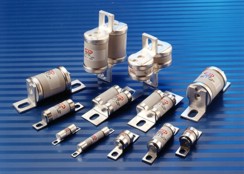
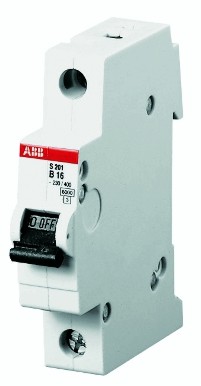
The pictures show a range of ABB fuses, as well as an ABB System pro M compact MCB.