























































Electrical safety remains a critical priority in all workplace environments, and the condition of socket outlets is a fundamental element of that safety.
.jpg?width=2560)
Socket testers are widely regarded as a frontline diagnostic tool, providing a rapid and accessible method of assessing whether a power outlet is functioning correctly. Their simplicity and immediacy make them a valuable aid in identifying potential hazards such as wiring faults or inadequate earthing. This helps to reduce the risk of electrical accidents and supports a safer working environment.
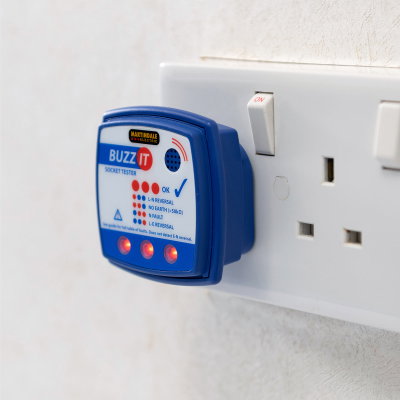
Socket testers are designed to provide quick feedback on the condition of a socket outlet. Using visual indicators, typically LEDs, and in some cases audible buzzers, they communicate whether a socket is correctly wired or if a fault is present. More advanced models can also give an indication of the quality of the earth connection. When used appropriately, socket testers are an effective means of highlighting potentially unsafe conditions that warrant further investigation.
Categories of Socket Testers
Socket outlet testers, commonly referred to as socket testers, are widely used by electricians and contractors. However, it is essential to understand both their limitations and the differences between the various types available. Socket testers generally fall into three categories: simple, advanced, and professional.
All three categories are capable of performing basic checks to confirm that live, neutral, and earth conductors are correctly connected. Test results are displayed through combinations of LEDs or audible alerts, allowing users not only to determine whether a socket is faulty but also to identify the specific wiring issue present. All socket testers should indicate the absence of an earth connection, while advanced and professional testers extend this capability by providing information about the quality of the earth.
Earth Loop Impedance and Its Importance
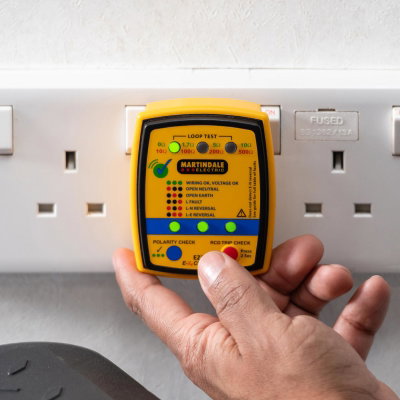
A key distinction between tester categories lies in their ability to assess earth fault loop impedance. Advanced and professional socket testers measure and display impedance either as a numerical value or within defined ranges. Simple socket testers do not provide this information and are unable to indicate when earth fault loop impedance is excessively high.
Some testers display earth quality using resistance range indication. Understanding these differences is crucial, as certain basic testers have been shown to indicate that an earth connection is “good” even when the impedance is extremely high. In such cases, the protective earth would not provide effective protection. Earth loop impedance values exceeding a few ohms can compromise safety, as over-current protection devices may not operate quickly enough to prevent electric shock. Socket testers capable of indicating earth loop impedance therefore provide a much more meaningful assessment of electrical safety than basic wiring indicators alone.
Faults Beyond the Scope of Socket Testers
There are certain wiring faults that socket testers, and indeed most test equipment, cannot easily detect. One such example is the reversal of earth and neutral conductors. Because earth and neutral are bonded at the substation, or sometimes closer to the installation, they are electrically indistinguishable at the socket outlet.
Additionally, while socket testers can identify wiring faults within the socket itself, they cannot normally detect reversed polarity on the incoming supply. This serious condition, where live and neutral are reversed upstream of the socket, requires a specific additional test. Some modern socket testers such as the Martindale BZ701 now include this functionality, typically activated via a touchpad interface.
Additional Features and Functions
Many socket testers, including basic models, incorporate an audible buzzer to indicate socket status. This feature can also be useful for identifying which circuit a particular socket is connected to. Some testers also include an RCD test function, allowing a basic functional trip test of the residual current device associated with the socket under test. It is important to note that this is a simple operational check and does not replace the formal RCD testing required under BS 7671, 18th Edition wiring regulations.
Industrial and Commercial Socket Testing
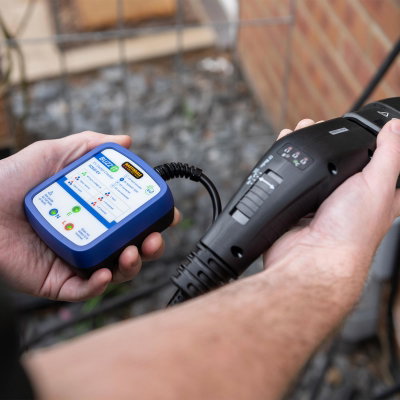
While socket testers are commonly associated with standard three-pin outlets, testers are also available for a range of commercial and industrial socket types. Industrial socket testers may perform similar basic tests but must accommodate various pin configurations, including four- and five-pin three-phase outlets, as well as differing voltage levels. For these applications, it is essential to define the testing requirements clearly and consult manufacturer specifications to confirm which tests are supported.
Compliance and Best Practice
BS 7671 requires that new, repositioned, or repaired socket outlets are not put into service until all necessary verification procedures have been completed. These procedures include continuity testing of protective conductors and ring final circuit conductors, insulation resistance testing, polarity verification, and earth fault loop impedance measurement. These checks should be carried out using appropriate individual instruments or multifunction installation testers.
Socket testers are not a substitute for full electrical installation verification. However, when correctly specified and used, they provide a fast and effective first-line indication of potentially unsafe wiring conditions. They are also valuable as a service tool, helping to identify hazards before working on existing electrical systems, installing new equipment, or carrying out preliminary checks prior to comprehensive installation testing.
Martindale Electric are the pioneers of socket testing, launching the classic, patented Ring Main Tester, the Check Plug in1968. Although records have been lost over time, the best estimate is that over 2,000,000 Check Plugs and follow on products have been manufactured and sold to date.
See more from Voltimum on Google
Add Voltimum as a preferred source and Google will show our articles more often in your news results.