

























-Promo-graphics-(2).png?width=1280)
-Promo-graphics-(1).png?width=800)

A new edition of one of the IET’s Codes of Practice aims to stem unacceptable practice in PAT testing, and in this article we look at the changes.

ON 28 NOVEMBER 2011, the Lofstedt report was published, highlighting a significant level of legislative over-compliance by industry. One key issue identified in the report was confusion over PAT testing – widely misunderstood as a requirement to carry out inspection and testing annually, regardless of equipment type, usage or environment. In fact, inspecting or testing annually has never been a requirement, and the new Code of Practice has been updated to emphasise and expand on this.
RISK ASSESSMENT
The fourth edition of the Code of Practice for In-Service Inspection and Testing of Electrical Equipment has been written to emphasise the need to ‘risk assess’ the requirement for any inspections and tests. Risk assessments are vital to understanding what can affect any electrical equipment in use, and to be sure of its continued safe use.
Any risk assessment process must be carried out by the duty holder, because he or she is solely responsible for the safety and maintenance of equipment in his or her care. A duty holder may use an outside consultant to advise on the type and frequency of any inspections or tests; however, the duty holder is responsible in all cases, regardless of any consultant’s advice.
In the past PAT testing has, in the majority of cases, been conducted by external contractors. These contractors have then, quite wrongly, set the frequency of the subsequent inspections and tests without consultation or input from the duty holder, and without an adequate – if any – risk assessment.
In many cases, Table 7.1 in the Code of Practice was used or misinterpreted as a definitive frequency chart. This is unnecessarily costing UK businesses a great deal of money each year. It has always been stressed that Table 7.1 is only intended to provide guidance on initial frequencies, and should only be used as a starting point where previous inspection and testing records and risk assessments are not available. Ongoing frequencies should be determined from a risk assessment.
IN THE OFFICE
Interestingly, there is a common misperception that general office areas are high-risk environments. In fact, office areas in general present very low levels of risk, and subsequent risk assessments and frequencies should reflect this. The HSE publication INDG236: ‘Maintaining portable electrical equipment in low-risk environments’, gives further guidance and information on these types of environments. Risk levels are, in practice, also generally low for large sever rooms in data storage, handling and call centres, etc, where, owing to the sensitive and critical nature of the information held, access is limited to persons directly responsible for upkeep and repair.
Continued...
To view the full article from the IET's Wiring Matters Autumn 2012, download the attachment at the end of this article.
View the full Autumn 2012 Issue of Wiring Matters by visiting the IET website here.
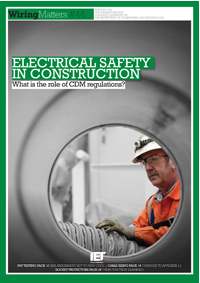 Autumn 2012 Issue of Wiring Matters Features:
Appendix 4 Conductor cross sectional area
Construction sites and CDM
What is an electrician?
Electric vehicles and PME
Electric vehicle charging
In-service Inspection and Testing
LED lighting
Wall socket protectors
See more from Voltimum on Google
Add Voltimum as a preferred source and Google will show our articles more often in your news results.