










Published: 12 July 2013
Category: Technical articles
Skip to content
-
-
Premium 8
-
Manufacturer 39
-
 Adaptaflex

-
 APC
APC
-
 BG Electrical
-
 Brady
Brady
-
 British Cables Company
-
 CPN Cudis
-
 Crabtree
-
 Dehn
Dehn
-
 Di-Log
-
 Doepke
-
 E-Klips
-
 Eaton
Eaton
-
 Electrium
-
 Emergi-Lite
-
 Fibox
Fibox
-
 flex7
flex7
-
 Furse
Furse
-
 Interact
-
 Kewtech
-
 KOPEX
KOPEX
-
 LEDVANCE
-
 Linian
-
 Luceco
-
 Marshall Tufflex
-
 Martindale Electric
-
 Masterplug
-
 Megger
-
 Nexans
-
 Philips
-
 Quickwire
-
 Rointe
-
 Shelly
-
 Siemens
-
 Signify
-
 Sync Energy
-
 TWISTTAIL
-
 TY-MET
-
 TY-RAP
-
 Wylex
Wylex
-
-
Distributor 8
- All partners
-
Shopping Cart

IET - Technical Article - Changes to the IET\'s Code of Practice for in-service inspection and testing of electrical equipment
IET
IET - Technical Article - Changes to the IET\'s Code of Practice for in-service inspection and testing of electrical equipment
Published: 12 July 2013 · Category: Technical articles
From this document
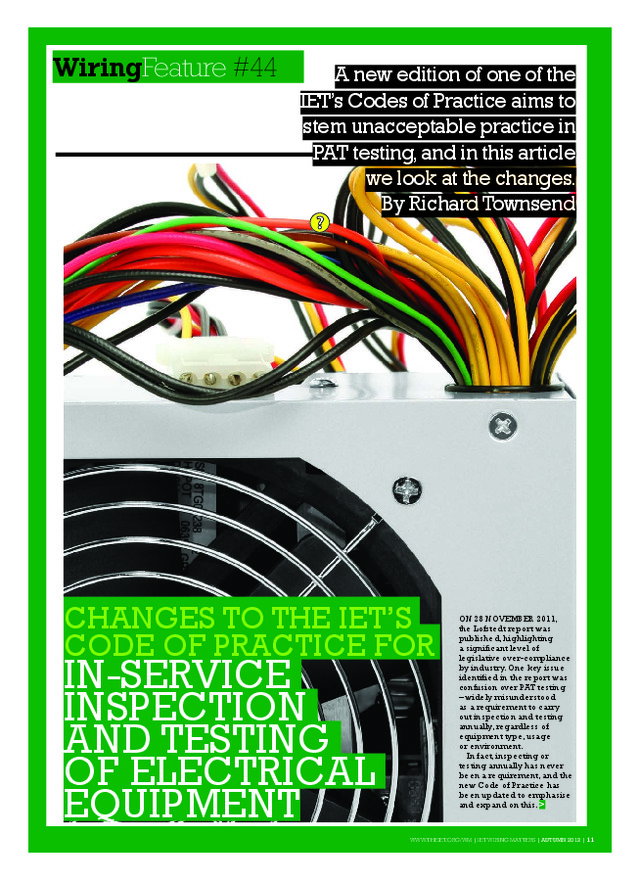
WiringFeature #44 A new edition of one of the IET’s Codes of Practice aims to stem unacceptable practice in PAT testing, and in this article we look at the changes. By Richard Townsend CHANGES TO THE IET’S CODE OF PRACTICE FOR IN-SERVICE INSPECTION AND TESTING OF ELECTRICAL EQUIPMENT ON 28 NOVEMBER 2011, the Lofstedt report was published, highlighting a significant level of legislative over-compliance by industry. One key issue identified in the report was confusion over PAT testing – widely misunderstood as a requirement to carry out inspection and testing annually, regardless of equipment type, usage or environment. In fact, inspecting or testing annually has never been a requirement, and the new Code of Practice has been updated to emphasise and expand on this. > WWW.THEIET.ORG/WM | IET WIRING MATTERS | AUTUMN 2012 | 11 DANGER DO NOT USE FAIL Date of check .................. ................................. RISK ASSESSMENT < The fourth edition of the Code of Practice for In-Service Inspection and Testing of Electrical Equipment has been written to emphasise the need to ‘risk assess’ the requirement for any inspections and tests. Risk assessments are vital to understanding what can affect any electrical equipment in use, and to be sure of its continued safe use. Any risk assessment process must be carried out by the duty holder, because he or she is solely responsible for the safety and maintenance of equipment in his or her care. A duty holder may use an outside...
Open the PDF