Electrical equipment and appliances must be regularly tested to ensure safety and comply with regulations. While visual inspection can detect several electrical safety issues with portable appliances, some problems can only be identified through testing.
.jpg?width=1200)
To ensure the safety of electrical equipment and appliances, regular testing is crucial. The most effective way to accomplish this is by performing Portable Appliance Testing (PAT) / Electrical Equipment Testing (EET) in combination with a visual inspection It sounds straightforward - and it is - but it’s important to stay up to date and ensure your knowledge remains current.
Here are four helpful ways to improve your approach to PAT/EET testing:
1. Understanding ‘competent’
The person conducting the testing must be ‘competent’ to do so. The 5th Edition of the IET Code of Practice defines ‘competence’ as “a person possessing sufficient technical knowledge or experience to be capable of ensuring that risk is prevented.” This means the person has the knowledge and training to know what to look for and when to escalate concerns.
They do not need to be an electrician or engineer, but must understand electrical risks, recognise what is acceptable, and be trained to carry out inspections correctly.
In lower-risk environments, a trained and knowledgeable staff member may be suitable for conducting a visual inspection. However, when both inspection and testing are involved, a higher level of expertise is recommended. This includes having the correct equipment, knowing how to use it properly, and the ability to interpret the test results accurately.
2. Continuous Learning
According to the Health and Safety Executive (HSE), 25% of all reportable electrical accidents involve portable appliances. From these figures, it is clear that a large number of incidents and injuries could be prevented with proper electrical checks, inspections and safety tests.
Keeping abreast of the latest regulations, industry guidance, and best practices not only strengthens your understanding of PAT/EET testing but also helps you approach each inspection more efficiently, confidently, and safely - helping reduce the risk of accidents and ensuring consistent, reliable results.
To make staying up to date easier, Martindale’s Resource Centre provides a central hub of information and tools to support ongoing learning and best practice in electrical safety, including PAT/EET testing. Offering a wide range of resources including product information, application notes, articles videos, and links to relevant industry guidance.
For example, Martindale’s Formal Visual Inspection checklist, is free to download and helps formalise your PAT/EET visual inspection to ensure nothing is overlooked.
3. Implement a maintenance programme
While PAT/EET testing are not legally required, employers are responsible for maintaining electrical equipment in safe working order to minimise the risk of accidents.
The HSE advises that the law does not specify how or how often maintenance should be carried out, so a risk-based approach is recommended, taking into account the type of equipment and how it is used. This should focus efforts on high risk areas and avoid unnecessary levels of testing / inspections in lower risk areas.
The HSE notes that user checks, carried out by a trained individual using a simple checklist, are a valuable part of ongoing maintenance. However, alongside these checks, formal visual inspections and PAT/EET testing by a ‘competent’ person form the foundation of any comprehensive maintenance programme, helping employers meet their legal responsibilities and maintain a safe working environment.
Depending on the type of equipment and its environment, these formal visual inspections and testing should be carried out at appropriate intervals.
Implementing a structured maintenance programme allows individuals to approach PAT/ EET testing more systematically, confidently, and efficiently, knowing their inspections are part of a well-planned safety strategy.
4. Practical, user-friendly test equipment
When carrying out PAT/ EET testing, it’s important to use test equipment that allow both contractors and competent in-house personnel to quickly and safely verify the electrical safety of all types of appliances.
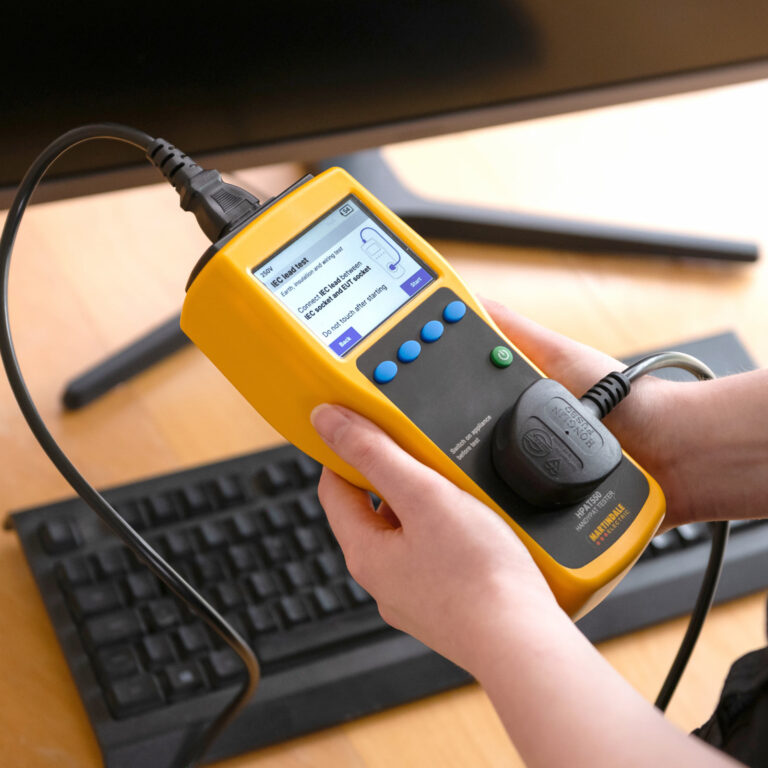
For example, designed to perform safety checks in line with the IET Code of Practice, Martindale Electric offers a range of PAT/EET testers, including the HPAT550 and HPAT650. These devices carry out critical safety tests on both Class I and Class II equipment, helping ensure appliances are safe and meet the maintenance requirements set out in the Electricity at Work Regulations (EAWR).
The Martindale HPAT550 Pat Tester and Martindale HPAT650 Pat Tester are handheld and battery powered. Built for ease of use, with one-button automatic testing, the small, lightweight design gives ultimate portability and durability. Both models feature a bright, high-quality colour display for user-friendly operation and can be charged via the integral USB-C charging port.
Key features include:
Compact, portable design
Clear and simple PASS / FAIL indication with measured values
Automatic testing Class I, Class II & IEC power lead tests
IT safe 200mA earth bond test
Selectable 250V or 500V insulation test
USB-C rechargeable, fast charge support and power save mode
Using practical, user-friendly test equipment helps ensure PAT / EET testing is efficient, safe, and reliable.
Improving PAT/ EET testing doesn’t rely on a single action. It’s about combining the right skills, knowledge, approach, and tools. Ensuring tests are carried out by a ‘competent’ person, keeping up to date with regulations and best practice, implementing a structured maintenance programme, and using practical, user-friendly test equipment all work together to make inspections safer, more efficient, and more reliable.
By focusing on these areas, you can enhance your PAT/EET testing approach, reduce risks, and have confidence that your electrical safety checks are thorough and effective.
To find out more, explore Martindale’s extensive resource centre.
With over 95 years of experience in electrical safety, Martindale Electric is one of the most trusted names in the industry delivering and supporting a wide range of test, measurement and safe isolation solutions. Focussed electrical safety products include Portable Appliance Testers, Safe Isolation devices, Socket Testers and Voltage Indicators.