
For anyone entering the electrical trade, learning about MCB’s is a fundamental first step.

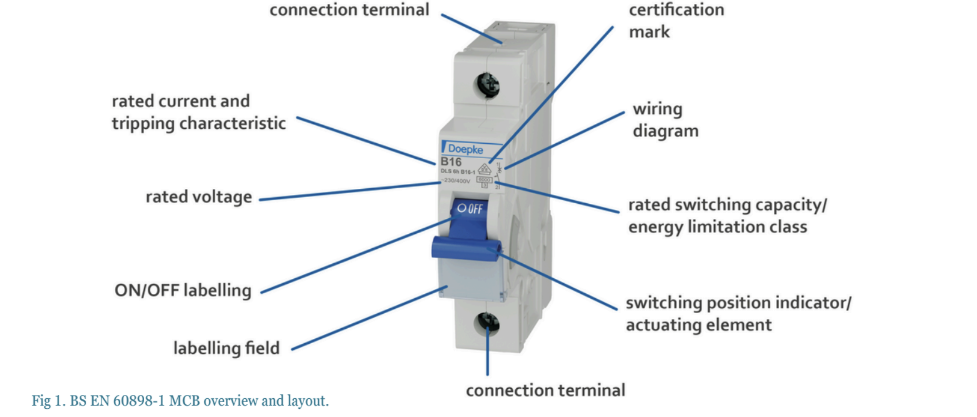
An MCB (Miniature circuit breaker) is an automatically operated electromechanical device designed to protect a circuit from overcurrent conditions and short-circuit faults. Unlike fuses, which require replacement after operation, an MCB can be reset once the fault has been cleared. An MCB is a commonly used generic term that does not appear in BS 7671 or the relevant product standards, where the correct term is circuit breaker.
Circuit breakers
There are two product standards for CBs. BS EN 60898-1 and BS EN 60947-2. CBs to BS EN 60898-1, commonly referred to as MCBs, have fixed characteristics with ratings up to and including <63A and are suitable for operation by “ordinary persons”. After breaking a short circuit, you must be able to reset the CB. The second standard, BS EN 60947-2, covers CBs with adjustable characteristics and ratings up to 1600A. These CBs are to be used by “instructed persons” and may not be suitable for reuse after breaking a short circuit.
Short circuit breaking capacity
To meet BS EN 60898-1, the ICN (rated short-service capacity) must be printed on the front of the MCB, e.g. 10kA. This represents the maximum short-circuit current the MCB can safely interrupt twice and still resume normal service when reset. There are additional short circuit breaking requirements at 75% of the ICN and a multiple of the rated current. For circuit breakers to BS EN 60947-2, two breaking capacities are defined: Icu (ultimate breaking capacity) and Ics, which is expressed as a percentage of Icu, typically between 25% and 100% selected by the manufacturer. Following a short-circuit trip, the instructed person must follow the companies maintenance policy before resetting the CB.
Domestic and similar installations
Distribution boards to BS EN 61439-3 require the rated conditional short circuit current (Icc) to be declared and verified by the manufacturer. This test confirms that the consumer unit can withstand a short-circuit current of 16kA when protected by a specific upstream protective device, e.g 100A BS88-2 fuse.
Energy limiting MCBs
BS EN 60898-1 classifies B and C characteristic MCBs up to and including 63A into energy-limiting classes 1 or 3. In the event of a short circuit, Class
3 MCBs offer superior performance by reducing the amount of let-through energy (I²t), thereby protecting downstream cables and components.
Tripping curves
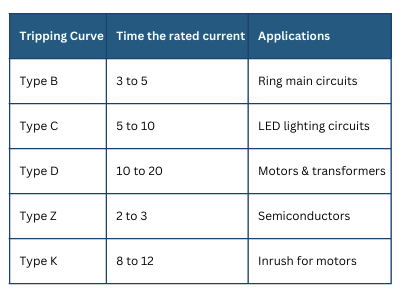
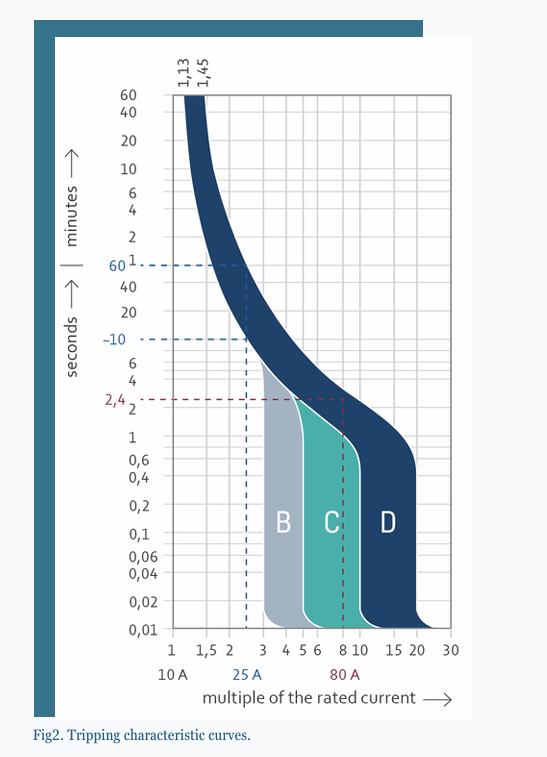
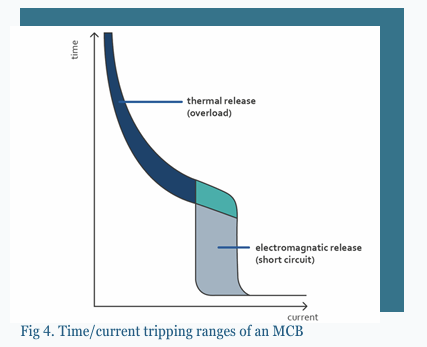
Tripping characteristic curves, issued by the manufacturer, illustrate the relationship between the current flowing through an MCB and the time taken for the breaker to trip. These curves ensure correct protection against both overcurrent and short-circuit conditions. MCBs to BS EN 60898-1 are classified according to their tripping characteristics, commonly known as B, C and D curves. General tripping characteristics for B and C curve MCBs can be found in BS 7671 Appendix 3. (D curves are not recognised for use in domestic applications.)
Overcurrent and short circuit release
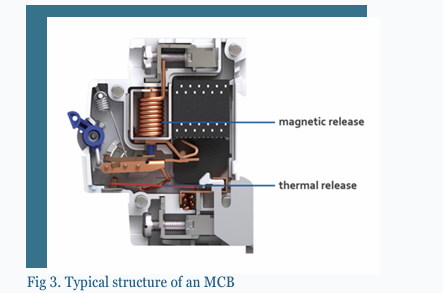
MCBs have two independent releases. Thermal release (Delayed release) and Magnetic release (instantaneous release)
Thermal release
Tripping in the delayed overload range occurs via a bimetal element that deflects as current flows through the MCB. The time taken to trip depends on the magnitude of the overcurrent. If the current remains below the rated current of the MCB, no tripping occurs. Once the tripping current is exceeded, delayed tripping takes place.
Magnetic release
The current flowing through the MCB generates a permanent magnetic field in the coil (electromagnet). When a short-circuit occurs, a large magnetic field is created in the coil due to the high current flowing through the MCB. This causes the latch to be triggered. Due to the rapid tripping, the electromagnetic release is also referred to as instantaneous release.
Conclusion:
An MCB is a commonly used generic term that does not appear in BS 7671 or the relevant product standards, where the correct term is circuit breaker.
MCBs are designed to either BS EN 60898-1, for operation by ordinary persons (commonly referred to as MCBs), or BS EN 60947-2, for use by instructed persons (often referred to as MCCBs).
MCBs manufactured to BS EN 60898-1 must have the short-circuit current rating marked on the front of the device. They also have defined energy-limiting classes, with Class 3 providing the highest level of protection for domestic applications, and tripping characteristics (B, C and D) suitable for applications ranging from domestic ring final circuits to industrial motor circuits.
Written By: Martin Plumbridge