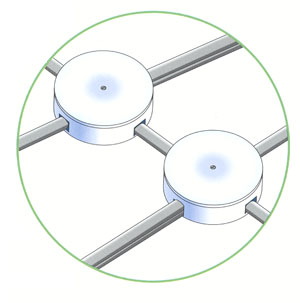
Circuit protective conductors should not be terminated outside a junction box.

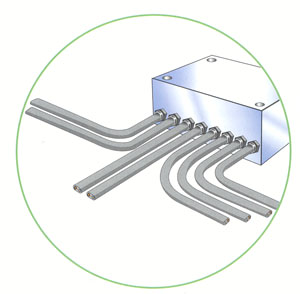
Circuit protective conductors (cpcs) are not always terminated properly at accessories, Instances have been observed of protective conductorss being terminated outside a junction box, as illustrated.
The snag with this method of termination is that the protective conductors are more likely to suffer damage due to being unenclosed and unprotected. A damaged cpc or connection could result in failure of the circuit to disconnect under earth fault conditions leading to a risk of electric shock or fire.
Solution
In the example shown where eight cables are to be terminated; one solution would be to employ two junction boxes.
The cores of sheathed cables must be enclosed. Regulations 526-03-02 and 526-03-03 refer.
Regulation 526-03-03 deals with the enclosure of the cores of cables from which the sheath has been removed and Regulation 526-03-02 gives details of the permitted types of enclosures. All the conductors of the cable must be taken into the junction box and terminated. The protective conductor must be terminated at each accessory as required by Regulation 471-08-08.
A copper protective conductor of cross-sectional area less than:
- 2.5 mm2
- 4 mm2
must be contained within the enclosure formed by a wiring system (Regulation 543--01-01 refers).
Regulation 471-08-08
In every innstallation which provides for protection against indirect contact by automatic disconnection of supply, a circuit protective conductor shall be run to and terminated at each point in wiring and at each accessory except a lampholder having no exposed conductive-parts and suspended from such a point.
Regulation 526-03-03
Cores of sheathed cables from which the sheath has been removed and non-sheathed cables at the termination of conduit, ducting or trunking shall be enclosed as required by Regulation 526-03-02.
Regulation 526-03-02
Every termination and joint in live conductor or a PEN conductor shall be made within one of the following or a combination thereof:
- a suitable accessory complying with the appropriate British Standard
- an equipment enclosure complying with the appropriate British Standard
- a suitable enclosure of material complying with the glow-wire test requirements of BS 6458-2.1
- an enclosure formed or completed with building material considered to be non-combustable when tested to BS 476-4
- an enclosure formed or completed by part of the building structure, having the ignitability characteristic 'P' as specified in BS 476 part 5.
Regulation 543-01-01 (part of)
The cross-sectional area of every protective conductor, other than an equipotential bonding conductor, shall be:
- calculated in accordance with Regulation 543-01-03, or
- selected in accordance with Regulation 543-01-04.
If the protective conductor:
- is not an integral part of a cable, or
- is not formed by conduit, ducting or trunking, or
- is not contained in an enclosure formed by a wiring system;
the cross sectional area shall not be less than 2.5 mm2 copper equivalent if protection against mechanical damage is provided, and 4 mm2 copper equivalent if mechanical protection is not provided.