

























































Smart heating control is no longer just about replacing a wall thermostat with an app-connected version. The right solution depends on what is being heated, how the system is controlled, how many zones are required and whether energy measurement is part of the brief.

A gas boiler with a potential-free thermostat input needs a very different approach from electric underfloor heating. A heat pump should not necessarily be controlled like a boiler, while a commercial building may require DIN-rail devices, Ethernet connectivity, energy monitoring and integration with a wider BMS.
For electricians and system integrators, this is where Shelly’s modular approach becomes useful. Rather than specifying one thermostat for every project, installers can combine relays, temperature sensors, smart radiator valves, energy meters and professional DIN-rail devices around the requirements of the heating system itself.
So which Shelly smart heating controls should you use? The answer starts with the system in front of you.
Quick guide: which Shelly setup fits which heating system?
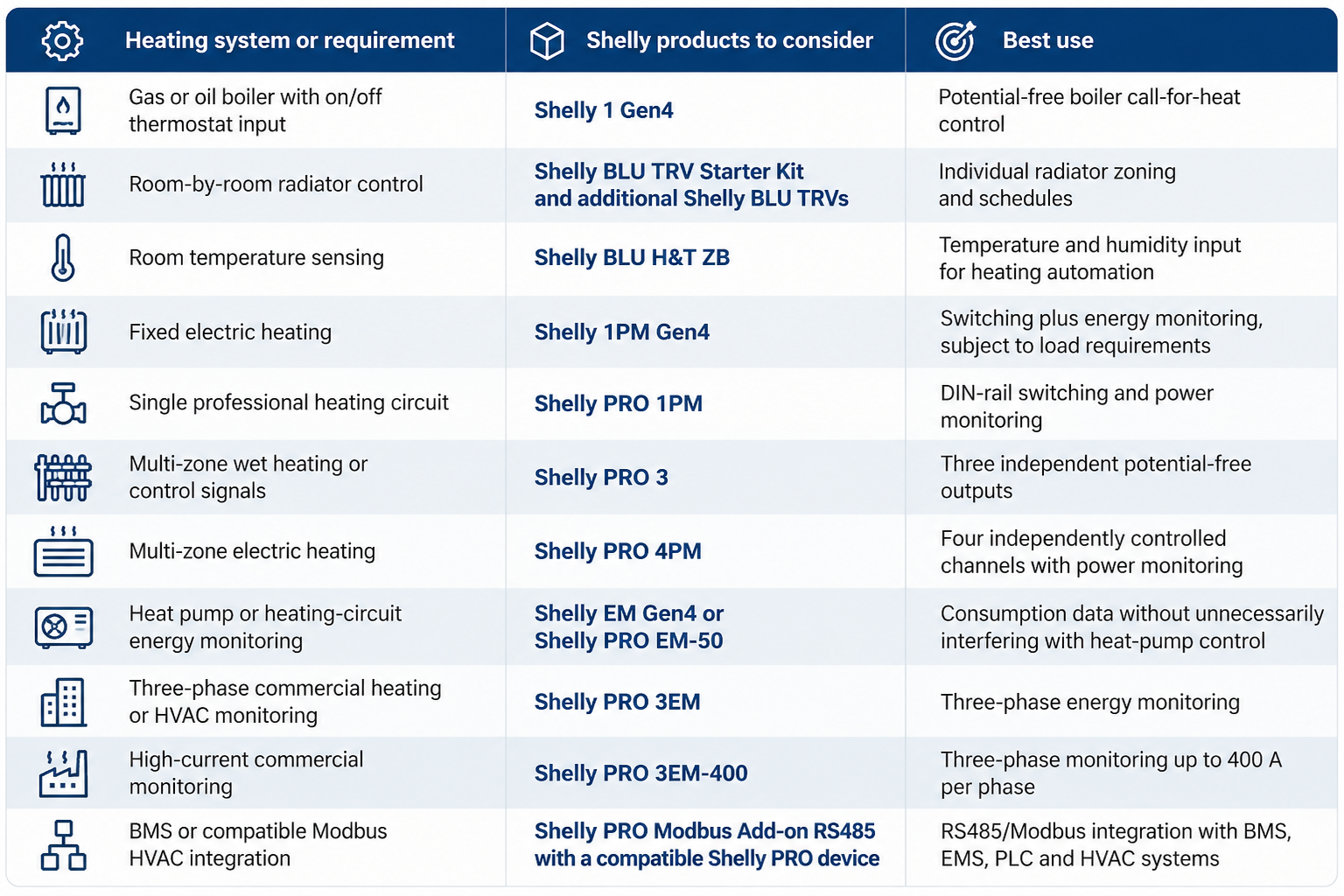
The key is to start with the heating architecture rather than the smart device. Once the control method, electrical load and number of zones are understood, the right Shelly products become much easier to specify.
1. Conventional boilers: use a dry-contact relay for the call for heat
For a conventional gas or oil boiler controlled through a simple on/off thermostat connection, a potential-free or dry-contact relay is usually the first product category to consider. The Shelly 1 Gen4 is particularly well suited to this type of retrofit because its relay output is electrically isolated from its own power supply.
Where the boiler manufacturer provides a compatible potential-free thermostat or enable input, the Shelly can replicate the switching function of a conventional thermostat while adding schedules, remote control and automation. Shelly 1 Gen4 also supports Wi-Fi, Bluetooth, Zigbee and Matter, making it easier to incorporate the heating system into a wider smart-home setup rather than creating another isolated control layer.
Temperature data can come from a sensor such as Shelly BLU H&T ZB, allowing an automation to request heat when room temperature falls below the required level. For projects where the customer wants a permanent physical interface rather than app-only control, the Shelly Wall Display X1i can provide touchscreen access to heating, scenes and other Shelly devices.
This type of setup is well suited to domestic boiler retrofits, apartments, rental properties and smaller commercial premises using simple thermostat demand signals. The key installer check is compatibility. Not every boiler should be controlled by simple on/off contacts, and systems using OpenTherm, weather compensation or proprietary modulating controls may lose functionality if the original controller is simply replaced by a relay. Always check the boiler manufacturer’s control interface first.
2. Radiator systems: move from one thermostat to room-by-room control
A single central thermostat has an obvious limitation: it only knows the temperature in one location. That can leave a home with a warm living room, an overheated spare bedroom and a cold home office while the boiler continues responding to one sensor in the hallway.
For standard radiator systems, the Shelly BLU TRV Starter Kit provides a straightforward route into room-by-room heating control. The Shelly BLU TRV regulates water flow through an individual radiator and supports schedules, boost operation and external sensor data, while additional Shelly BLU TRVs can extend the system across more rooms.
That makes zoning much more granular. Bedrooms can follow one schedule, living areas another, while rarely used rooms can operate at a lower setpoint. A separate Shelly BLU H&T ZB can also provide more representative room-temperature data away from the radiator itself, which is useful where the temperature beside the radiator does not reflect conditions elsewhere in the room.
For houses and apartments with radiator-based central heating, this gives customers a more targeted approach to comfort without having to heat every room in the same way at the same time.
3. Electric heaters and immersion heaters: control and measure the load
Electric heating changes the product-selection criteria because the Shelly device may be switching the heating load itself rather than simply sending a demand signal to a boiler. That makes electrical rating, circuit design and energy measurement much more important.
For a suitable single-phase fixed electric heater or heating circuit, Shelly 1PM Gen4 combines control with power measurement. That means the load can be switched according to temperature, schedule or other automation logic while also giving the user visibility into how much electricity it is actually consuming.
That extra layer of data is increasingly valuable as customers combine smart heating with time-of-use tariffs, solar PV, batteries and wider home energy-management strategies. Hot-water cylinders are a good example. Instead of relying only on a basic timer, a suitable Shelly setup can make an immersion heater responsive to schedules, available solar generation, tariff periods or other energy conditions. For a practical installer-focused example, eFIXX demonstrates the concept in This Shelly Relay Makes Any Immersion Heater Smart.
For higher-load or long-duration heating applications, the headline relay current alone should not determine product selection. Load characteristics, circuit design, protective devices, installation conditions and manufacturer instructions all need to be considered, and in some applications a Shelly device is better used to control a correctly selected contactor.
4. Electric underfloor heating: retain the safety controls
Electric underfloor heating is another strong automation opportunity, but it is important to separate smart control from temperature safety. Many electric floor-heating systems require a dedicated floor-temperature sensor and thermostat to ensure the floor covering and heating element stay within their specified limits, so a general room-temperature sensor should not automatically be treated as a substitute.
Shelly can instead sit around the approved control architecture. For smaller retrofit installations, Shelly 1PM Gen4 can provide smart switching and energy measurement where the electrical design and load are suitable. For distribution-board installations, Shelly PRO 1PM offers DIN-rail control and metering of a single circuit, while Shelly PRO 4PM can support several independently controlled zones with individual power monitoring.
This creates a useful professional architecture. The required floor-temperature protection remains in place, while Shelly adds scheduling, remote control, automation and energy insight around it.
5. Wet underfloor heating and multi-zone systems: move control to the distribution board
Wet underfloor heating presents a different challenge because there may be several zone actuators, valves or demand signals to coordinate rather than one large electrical heating load. In these systems, centralising the control layer in the distribution board can make more sense than putting intelligence in individual rooms.
For professional DIN-rail installations, Shelly PRO 3 provides three independent potential-free outputs. That makes it useful where an installer needs to control separate heating zones, valves, contactors or compatible plant-enable inputs from one panel.
Because the outputs are potential-free, the Shelly PRO 3 offers more flexibility when the control side of the heating installation does not share the relay’s own supply voltage. It also brings wired networking and professional integration options into the panel, which can be particularly useful in larger homes, plant rooms and light-commercial installations.
For bigger projects, multiple Shelly PRO devices can form part of a modular control architecture rather than requiring every zone to depend on a single proprietary heating controller.
6. Heat pumps: monitoring may be more valuable than simple switching
Heat pumps deserve their own category because simply turning them on and off like a traditional boiler is often not the best control strategy. Many are designed to operate for long periods at relatively low flow temperatures, using weather compensation, compressor modulation and manufacturer-specific logic to maintain efficiency.
Aggressive external cycling or room-by-room shut-off can work against that strategy, which is why the first Shelly product on a heat-pump project may be an energy meter rather than a relay. For single-phase systems, Shelly EM Gen4 can monitor selected circuits using current transformers, while Shelly PRO EM-50 provides a DIN-rail option with two measurement channels, Ethernet connectivity and professional integration features.
For three-phase heat pumps or larger installations, Shelly PRO 3EM can monitor consumption across three phases, while Shelly PRO 3EM-400 extends that approach to higher-current applications.
This gives homeowners, installers and facilities teams a clearer view of actual heating electricity consumption and operating patterns without unnecessarily interfering with the heat pump’s own control strategy. Where a heat-pump manufacturer explicitly provides a compatible external enable or demand input, a potential-free device such as Shelly PRO 1 can also be considered. The appliance manufacturer’s control requirements should always determine the design.
7. Commercial heating and HVAC: use Shelly PRO as the control layer
Commercial projects introduce a different set of priorities. Panel mounting, wired networking, multi-zone control, energy monitoring and integration with BMS or energy-management platforms may matter more than simply having app control.
This is where Shelly PRO devices become particularly relevant. For potential-free control of a plant-enable signal or single zone, Shelly PRO 1 provides DIN-rail mounting, Ethernet, Wi-Fi and a dry-contact output. Where three independent potential-free controls are required, Shelly PRO 3 can handle multiple valves, contactors or compatible HVAC control signals.
For electrical HVAC or heating circuits where monitoring is also required, Shelly PRO 4PM combines four controllable outputs with individual power measurement. At whole-system level, Shelly PRO 3EM provides three-phase energy visibility that can help facilities teams identify plant operating outside expected hours, quantify heating demand and verify the impact of energy-efficiency measures.
This reflects the broader direction of smart-building projects, where control and energy data increasingly sit together rather than being treated as separate systems.
Taking commercial integration further with Modbus
Where a project needs integration with an existing Building Management System, Energy Management System, PLC or compatible HVAC equipment, the Shelly PRO Modbus Add-on RS485 can add RS485/Modbus communication to compatible Shelly PRO devices.
That creates a useful middle ground for commercial retrofits. Installers can add targeted monitoring or automation while still working with an existing BMS or control platform, rather than replacing the whole building-management architecture.
For offices, retail premises, hospitality, schools, multi-zone buildings and plant rooms, this can make Shelly PRO a practical control and monitoring layer inside a wider building system.
8. Smart heating as part of a wider home energy system
Heating is increasingly being considered alongside the rest of the building’s energy use rather than as a standalone system. Once consumption is measured, heating can become part of a broader strategy incorporating solar PV, batteries, EV charging, dynamic tariffs and other flexible electrical loads.
Electric heating or hot water can be scheduled around lower-cost tariff periods. Heat-pump consumption can be compared with building demand. Commercial HVAC running outside occupancy hours can be identified, while surplus solar generation can become a trigger for flexible loads such as immersion heating.
This is where Shelly’s modular approach becomes particularly useful. An energy meter can provide the data, a relay or contactor-control device can act on it, and automation can connect those elements to other conditions within the property.
For a hands-on example of Shelly being used as part of a wider energy project, see this OY Electrical demonstration. It reinforces the wider point that smart heating does not need to operate as an isolated subsystem. It can become one controllable part of the building’s overall energy strategy.
Three questions to ask before specifying smart heating controls
Whichever heating technology is being used, three questions will usually determine the right Shelly setup.
First, what signal does the heating equipment expect? A boiler thermostat input, 230 V heating element, zone actuator and RS485 heat-pump interface are fundamentally different things, so the electrical and communications interface should always be identified before choosing the smart-control device.
Second, does Shelly need to switch the load or only provide a control signal? If it is only signalling a boiler or contactor, potential-free contacts may be the priority. If it is switching an electric heating circuit directly, load rating, protective devices and power measurement become much more important.
Finally, how many zones need independent control? For one room, a simple relay and temperature sensor may be enough. For a house with radiator zoning, smart TRVs may make more sense, while a commercial building or multi-zone plant room may be better centred on Shelly PRO devices in the distribution board.
Those three questions prevent one of the most common mistakes in smart heating: choosing the product first and then trying to make the heating system fit it.
Smart heating control is also an energy-management opportunity
The bigger opportunity for installers may go beyond temperature control alone. Once heating consumption is measured, it can become part of a wider energy-management strategy incorporating tariffs, solar PV, batteries and other flexible electrical loads.
Electric heating can be scheduled around lower-cost tariff periods, while heat-pump consumption can be compared with outdoor conditions and building demand. In commercial premises, HVAC operating outside occupancy hours can be identified and corrected, while high heating demand can become one input into a wider load-management strategy.
This is why combining control with measurement is increasingly valuable. A system that simply turns the heating on and off provides smart control; a system that also shows where, when and how much energy is being used becomes a genuine energy-management tool.
Frequently asked questions about Shelly smart heating controls
Can Shelly control a gas boiler?
Yes, where the boiler provides a compatible on/off or potential-free thermostat input. A dry-contact relay such as Shelly 1 Gen4 or Shelly PRO 1 can be used to provide a call-for-heat signal.
Boilers relying on proprietary or modulating controls should be assessed separately rather than automatically replacing their controller with an on/off relay.
Can Shelly create individual heating zones?
Yes. Radiator systems can use Shelly BLU TRV for room-by-room temperature control, while wired heating zones can be automated using suitable Shelly relays or Shelly PRO devices.
Which Shelly device is best for electric heating?
For a suitable single heating circuit where direct power switching and measurement are required, Shelly 1PM Gen4 is a useful retrofit option. Shelly PRO 1PM provides a DIN-rail alternative, while Shelly PRO 4PM can control and measure multiple circuits.
The electrical load and installation requirements should always be checked before selecting a device.
Can Shelly make an immersion heater smart?
Yes. A suitable Shelly relay or professional control setup can add scheduling, remote control and energy-management logic to an immersion-heater circuit, provided the electrical design and switching arrangement are appropriate for the load.
Installers can see a practical example in eFIXX’s This Shelly Relay Makes Any Immersion Heater Smart.
Can Shelly control electric underfloor heating?
Shelly can add scheduling, remote control and energy monitoring to electric underfloor-heating installations, but required floor-temperature sensors and safety controls should remain part of the system. For multi-zone installations, DIN-rail Shelly PRO devices can provide a cleaner centralised architecture.
Can Shelly be used with heat pumps?
Yes, but the best application depends on the heat pump. Energy monitoring with Shelly EM Gen4, Shelly PRO EM-50 or Shelly PRO 3EM is broadly useful.
Direct control should only use an interface supported by the heat-pump manufacturer, such as an approved external demand input or compatible communications interface.
Is Shelly suitable for commercial heating controls?
Yes. Shelly PRO products are designed for professional DIN-rail installations and can provide potential-free control, multi-channel switching, energy monitoring, Ethernet connectivity and integration with wider automation platforms.
Compatible Shelly PRO devices can also be extended with the Shelly PRO Modbus Add-on RS485 for BMS, EMS, PLC and HVAC integration.
Does smart heating with Shelly need the cloud?
Many Shelly relay and Shelly PRO devices support local control, schedules and local integrations, allowing core automation to operate without depending entirely on cloud services.
Battery-powered BLU products use Bluetooth or Zigbee and require an appropriate gateway or compatible Shelly device when they need to be incorporated into the wider Shelly Smart Control environment.
Choose the heating architecture first, then choose the Shelly
There is no single “best smart thermostat” for every building because there is no single type of heating system. A conventional boiler may only need a potential-free relay and temperature sensor, while a radiator system benefits from room-level TRVs. Electric heating makes power measurement far more valuable, underfloor heating requires careful coordination with temperature-safety controls, and heat pumps often benefit more from monitoring and intelligent integration than indiscriminate switching.
Commercial projects add another layer, with DIN-rail devices, wired networking, multi-zone control and BMS integration becoming increasingly important. In each case, the value of a modular approach is that the control architecture can be built around the way the building and its heating system actually work, rather than forcing every application into a single closed thermostat ecosystem.
Installation and product selection should always follow the heating-equipment manufacturer’s instructions, the electrical characteristics of the load and applicable electrical regulations. Where required, use appropriately rated contactors, protective devices and safety controls.
See more from Voltimum on Google
Add Voltimum as a preferred source and Google will show our articles more often in your news results.