
























-Promo-graphics-(2).png?width=1280)
-Promo-graphics-(1).png?width=800)

Solar PV installations are more sophisticated. For installers, it is no longer about how much electricity an array can generate, but what happens after.

As solar is increasingly installed alongside battery storage, EV charging, heat pumps and other significant electrical loads, managing the flow of energy around a property is becoming an important part of system design.
This is particularly relevant where export to the grid needs to be limited or prevented. A zero-export – sometimes called zero-feed-in – PV system is designed to prevent surplus solar generation being exported to the public electricity network. There are several reasons why this might be required, from grid connection constraints and DNO requirements to projects where maximising on-site consumption is the priority.
Whatever the reason, effective energy management starts with one fundamental requirement: knowing what is happening at the grid connection point. How much electricity is the property consuming? How much is the PV system producing? Is the installation currently importing or exporting electricity? And, if surplus solar is available, are there loads elsewhere in the property that could make better use of it?
This is where Shelly can play an important role. Through real-time energy monitoring, local automation and integration with other electrical systems, Shelly can provide an intelligent monitoring and automation layer around a PV installation.
Importantly, however, energy management and formal export limitation are not necessarily the same thing. Where a DNO or grid connection agreement requires a compliant export-limitation scheme, the appropriate approved equipment and system architecture must be used. Shelly can complement that solution with additional monitoring and automation, rather than automatically being treated as the certified export-limitation mechanism itself.
How does a zero-export PV system work?
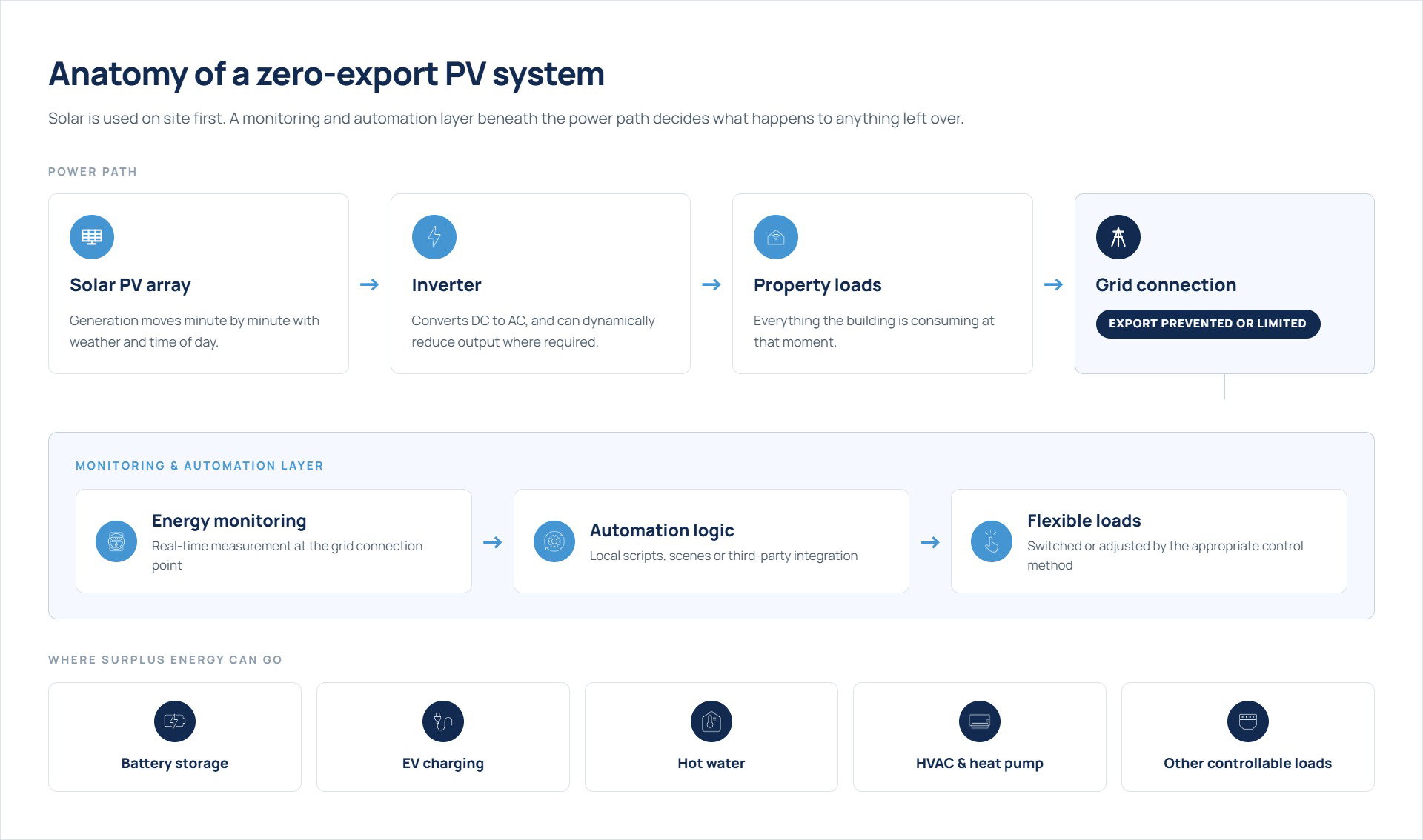
In a conventional grid-connected PV installation, solar generation is first available to loads within the property. If the array is producing more electricity than the building requires at that moment, the surplus can be exported through the grid connection.
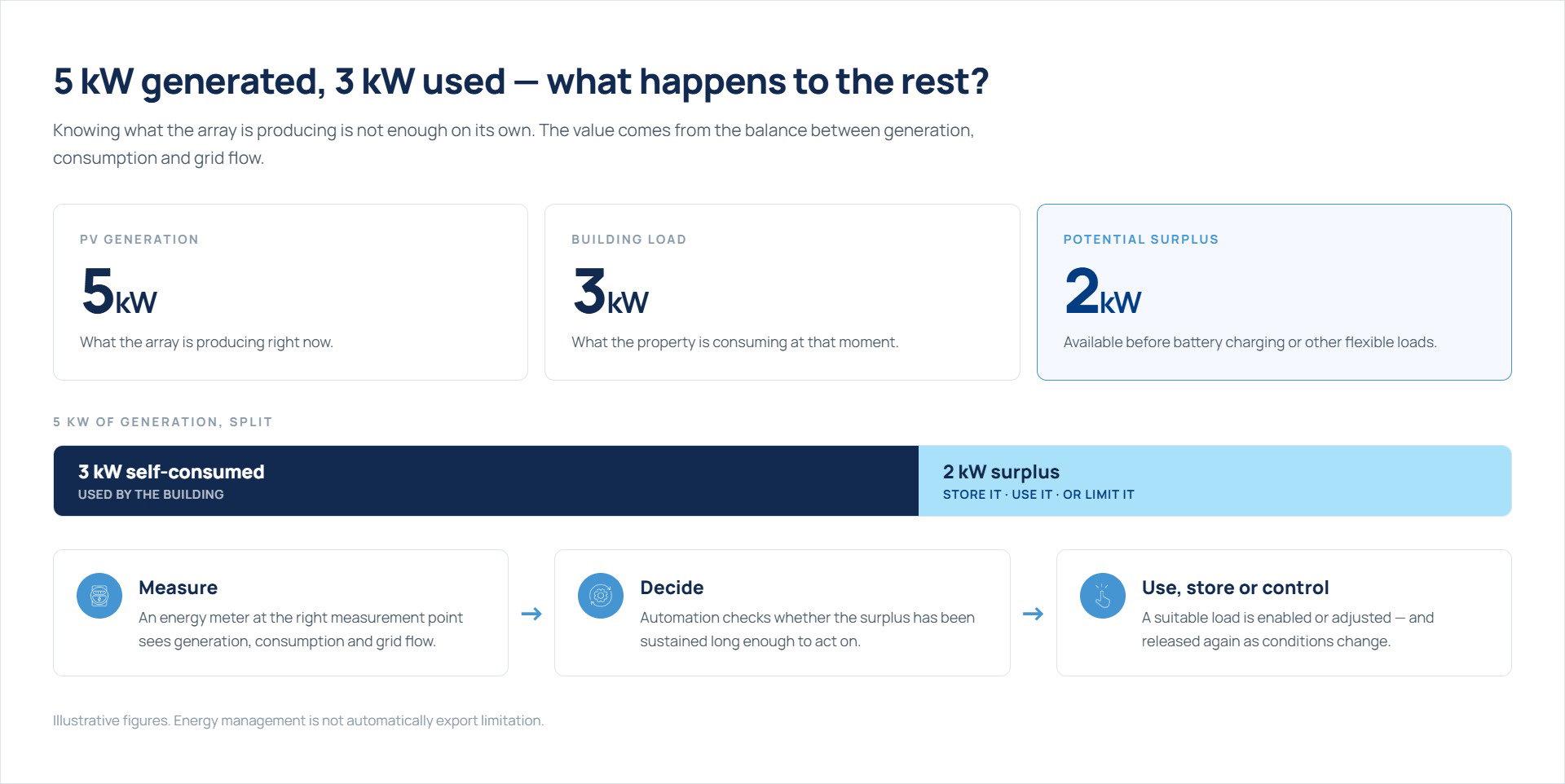
Consider a property generating 5kW from its PV system while its electrical demand is 3kW. Without battery storage, additional controllable demand or an export restriction, approximately 2kW is available for export. A zero-export system needs to prevent that surplus from passing onto the public network.
Depending on the installation, that could involve dynamically reducing inverter output, storing excess generation in a battery, increasing appropriate loads within the property, or combining several of these approaches. For an installer designing the wider energy-management strategy, accurate measurement is therefore critical. Knowing that the PV array is generating 5kW is useful, but it does not tell you whether the building is consuming 1kW, 3kW or the full 5kW.
Measurement at the appropriate point in the electrical installation provides that missing context.
Anatomy of a zero-export PV system
Where does Shelly fit?
For professional installations, the Shelly Pro 3EM provides three-phase energy metering in a DIN-rail format, using current transformers to measure electrical consumption. It can give installers and building owners detailed visibility of energy behaviour and can become a source of real-time information for wider automation.
This distinction between measurement and control is important. The device measuring the overall energy flow does not necessarily have to be the device controlling the load. In a larger installation, a Shelly energy meter might establish that surplus generation is available, while another Shelly device, local script or integration with a third-party system determines how the property should respond.
For targeted monitoring applications, Shelly EM Gen4 can also provide real-time power monitoring using current-transformer clamps. This can be useful where installers want visibility of particular circuits or energy flows rather than – or in addition to – whole-property three-phase measurement.
The result is a modular approach. Instead of treating the PV inverter as an isolated system, installers can start to build an energy-management architecture around the wider property.
Which Shelly product should I use?
What does the installation need? | Shelly product to consider | Role in the system | Best suited to |
Whole-property three-phase energy monitoring | Measures three-phase electrical consumption and energy flow using CT clamps | Professional PV, commercial and larger residential installations | |
Targeted circuit or energy-flow monitoring | Measures electrical demand on selected circuits using CT clamps | Monitoring PV, major loads or specific sections of an installation | |
Switching larger suitable loads | Provides three independently controllable relay channels | Load management and professional DIN-rail automation | |
Switching with power measurement | Combines controllable outputs with power monitoring | Individual circuits where switching and measurement are both required | |
Plug-in load monitoring and automation | Provides appliance-level monitoring and control | Suitable plug-connected discretionary loads | |
Building-wide energy automation | Connects measurement, automation and third-party integrations | Solar combined with batteries, EV charging, heating and other smart-building systems |
The important design principle is that measurement and control do not need to be performed by the same device. In a more sophisticated installation, Shelly Pro 3EM might monitor energy flow at the grid connection while another Shelly device, local script or third-party integration responds to the data. This gives installers freedom to select the most appropriate control method for each load rather than designing the entire installation around one piece of hardware.
Turning surplus solar into useful energy
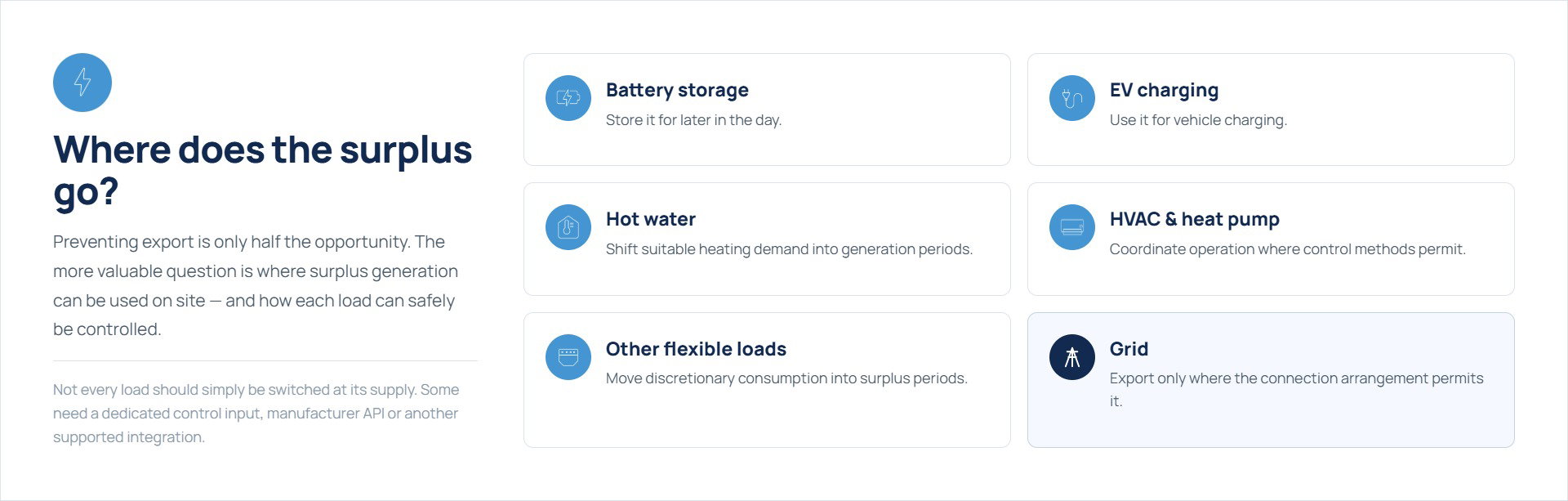
For many customers, preventing export is only half of the opportunity. The more valuable question is whether surplus generation can be used elsewhere in the property.
A home or commercial building may contain a growing number of potentially flexible electrical loads, including EV charging, hot-water heating, HVAC equipment, heat pumps, pumps, battery storage and other discretionary loads. If those systems can be appropriately controlled, solar generation can become an input into the building’s automation strategy.
Imagine that monitoring at the grid connection identifies a sustained solar surplus. Rather than simply allowing that energy to be exported, an automation could make an appropriate load available. As solar production subsequently falls, or demand elsewhere in the property rises, the automation can respond again to avoid replacing self-generated electricity with unnecessary grid imports.
The important word here is appropriately. Not every electrical load should simply be switched on and off at its power supply. Some equipment requires a dedicated control input, manufacturer API, communications protocol or another supported integration. The role of the installer is therefore to establish not only what can be controlled, but how it should be controlled safely and reliably.
This is where the breadth of the Shelly professional range becomes useful. DIN-rail devices including Shelly Pro relays can provide switching and automation capabilities where appropriate, while Shelly’s wider integration options allow energy data to interact with other systems.
Where does the surplus go?
A Shelly energy meter installed at the appropriate measurement point can give the wider automation system visibility of that energy flow. If a suitable flexible load is available, automation could respond to sustained surplus generation by enabling or adjusting that load. If PV output later falls or building demand increases, the load can respond again to avoid unnecessarily importing electricity from the grid.
This is a useful distinction for installers because it moves the conversation beyond simple generation monitoring. The value comes from understanding the balance between generation, consumption and grid flow, then using that information to influence how the property behaves.
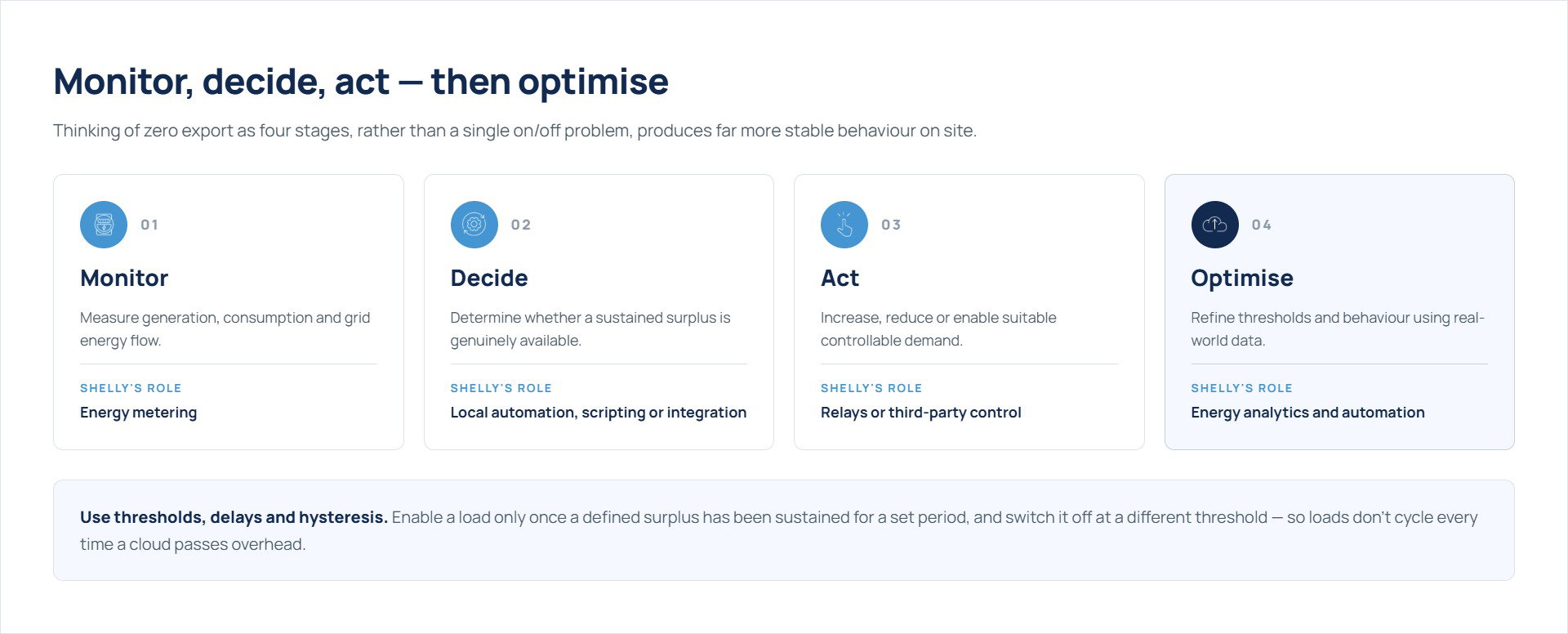
Monitor, decide, act
One of the simplest ways to think about Shelly’s role in solar energy management is as a three-stage process: monitor what the electrical system is doing, decide whether action is required, then control an appropriate load or system.
The advantage of this approach is that it avoids treating zero export as a simple on/off problem. A well-designed installation can take account of thresholds, time delays and hysteresis so that loads do not cycle constantly as clouds pass overhead or demand within the property fluctuates.
For example, a controllable load could be enabled only after a defined amount of surplus generation has been sustained for a set period. It could then use a different threshold for switching back off. This creates more stable behaviour and helps avoid automation reacting to every small movement in power flow.
Why local automation matters
Energy management is a particularly good example of why local control can be valuable. Solar generation can fluctuate quickly as weather conditions change, while building demand is continually moving as appliances and equipment start and stop.
Shelly’s ability to support local automation and on-device functionality means that the building does not necessarily need to send every measurement to the cloud, wait for a remote service to make a decision and then return an instruction before an action can occur.
Cloud connectivity remains useful for remote management, historical information and system oversight, but local intelligence can provide a resilient and responsive foundation for automation.
For installers, this becomes increasingly important as the number of interconnected electrical systems grows.
Monitoring is not the same as export limitation
This is one of the most important distinctions for installers considering Shelly for a zero-export project.
Important: energy management is not automatically export limitation.
Shelly can measure electrical energy flows and provide automation capabilities that help a wider energy-management system respond to surplus PV generation. Where a DNO or grid connection agreement requires a formal export-limitation scheme, installers must use equipment and an architecture that satisfy the applicable requirements. Shelly should therefore be considered part of the wider monitoring and energy-management solution unless the complete export-control arrangement has been specifically approved for that purpose.
This distinction changes the way the system should be specified. Rather than asking, “Can Shelly stop this PV system exporting?”, a more useful question is, “How can Shelly help this property understand and make better use of the energy available before it reaches the point of export?”
Choosing the right monitoring approach
For a straightforward PV system where the customer only wants to know how much electricity the array is generating, the monitoring supplied by the inverter may already be sufficient. Adding additional hardware simply to duplicate the same information is unlikely to add much value.
If the requirement is to understand the relationship between generation, building demand and grid import or export, whole-property energy monitoring becomes much more useful. On an appropriate three-phase installation, this is where Shelly Pro 3EM should enter the conversation.
Where only a particular circuit or flow needs to be monitored, Shelly EM Gen4 may be more appropriate. There are also installations where multiple measurement points make sense. An installer might want visibility of the grid connection while separately monitoring PV generation, EV charging or another major load.
That additional data can make the automation significantly more intelligent. Instead of simply knowing that the property is consuming 6kW, the system can begin to understand where that demand is coming from and make decisions accordingly.
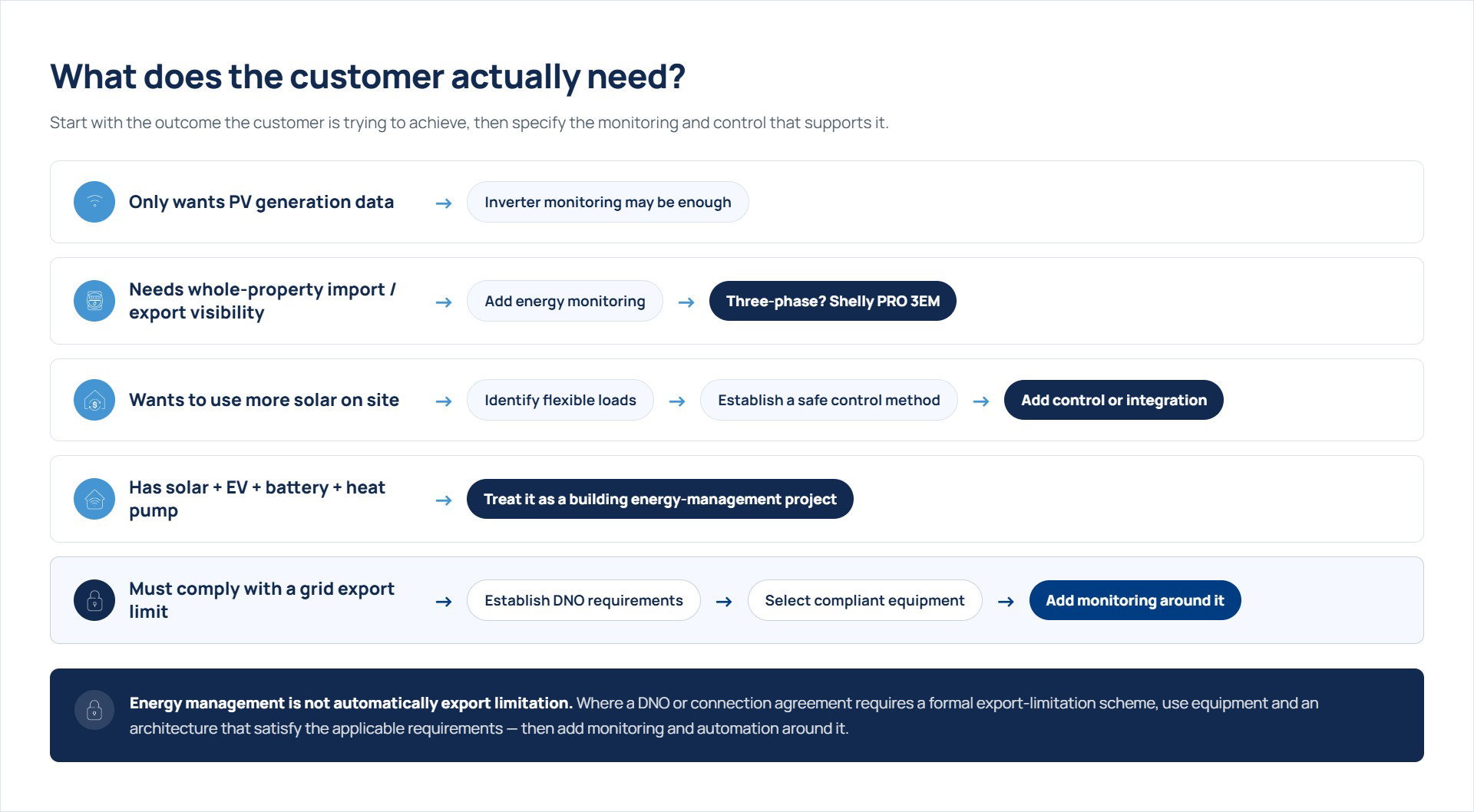
A practical decision guide for installers
For installers, the first question should always be what the customer is actually trying to achieve.
If the customer only wants to see PV generation, inverter monitoring may already be sufficient.
If they need to understand whole-property import and export, add energy monitoring at the appropriate point. On a three-phase installation, Shelly Pro 3EM is the natural product to consider.
If the aim is to increase solar self-consumption, identify which loads are genuinely flexible, establish how they can be controlled safely and then introduce the appropriate Shelly control or integration.
If the property combines solar, batteries, EV charging, heat pumps or other significant electrical loads, the project should increasingly be treated as a building energy-management system rather than simply a PV installation.
If a mandated grid export limit applies, establish the DNO or network requirements first and select the compliant export-limitation solution before building any supplementary Shelly monitoring or automation around it.
From zero export to smarter buildings
Zero-export PV is ultimately one example of a much bigger change taking place in electrical installations. As more energy is generated, stored and consumed within the same property, the electrical system needs to become more responsive.
For installers, that creates an opportunity to move beyond fitting individual pieces of equipment. A PV array does not have to operate independently from the EV charger. The EV charger does not have to be oblivious to the battery. Heating does not necessarily have to run without any knowledge of what the solar array is producing.
With appropriate monitoring, integration and automation, these systems can increasingly work as parts of the same energy ecosystem.
That is the role Shelly can play. Products such as Shelly Pro 3EM and Shelly EM Gen4 provide visibility of what electricity is doing, while the wider Shelly ecosystem gives installers the tools to turn that information into useful automation.
For a zero-export project, the starting point is understanding energy at the grid connection. The bigger opportunity is using that information to make the entire property smarter about when – and how – it consumes electricity.
See more from Voltimum on Google
Add Voltimum as a preferred source and Google will show our articles more often in your news results.