






















































Insulation is fundamental to the safe and reliable operation of electrical equipment. Whether in motors, generators, transformers or cables, insulation integrity helps protect equipment from failure while reducing the potential danger to those working with electrical systems.

However, insulation does not remain unchanged throughout the life of equipment. Thermal stress, electrical stress, contamination and moisture can all affect its performance over time.
For engineers involved in installation, servicing and maintenance, establishing the condition and integrity of insulation is therefore an important part of electrical testing. While a conventional insulation resistance measurement provides a useful indication of insulation condition at a particular point in time, a single measurement does not always provide the complete picture. By observing how insulation resistance changes over a defined period, engineers can obtain additional diagnostic information through established methods such as the Polarisation Index (PI) and Dielectric Absorption Ratio (DAR).
Insulation test fundamentals
At its simplest, insulation testing measures the condition of a conductor's insulation and the internal insulation of electrical equipment, with the objective of establishing whether the insulation is performing as expected and identifying any indication of deterioration.
The choice of test equipment and method depends on the application, as equipment may need to be tested during installation, routine servicing, or longer-term maintenance. Important considerations include the range of equipment to be tested, the voltage requirements, whether testing involves one-off measurements or longer-term monitoring, and the environment in which testing will take place.
The safety rating of the instrument, operator skill level, and conditions in which the tester will be used are also relevant. Where the objective is to monitor insulation degradation or obtain a more detailed indication of insulation condition, diagnostic measurements such as PI and DAR can provide information beyond a single insulation resistance value.
Measuring change over time - Polarisation Index.
The Polarisation Index (PI) is used to help assess the insulation condition of high-voltage equipment such as motors, generators and transformers. PI is calculated from the ratio of the insulation resistance measured at 10 minutes to the insulation resistance measured at 1 minute after applying a DC voltage test.
PI can help identify moisture ingress, surface contamination and insulation ageing, and is a preferred measurement for large motors and transformers.
Dielectric Absorption Ration (DAR) – a faster approach
The Dielectric Absorption Ratio (DAR) uses a similar diagnostic approach to PI, but over a shorter measurement period. DAR is the ratio of insulation resistance measured at 60 seconds to the insulation resistance measured at 30 seconds after applying a DC test voltage.
The shorter test period makes DAR particularly useful when time does not allow for the full 10-minute PI test. It is more commonly applied to smaller equipment or field applications, where a fast indication of insulation condition can be valuable.
DAR gives a fast screening method, while PI provides a more thorough evaluation of long-term dielectric performance.
Selecting an Insulation tester
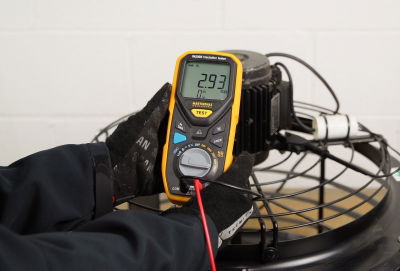
The requirements of an insulation tester extend beyond its ability to measure insulation resistance. The Martindale IN2203 Advanced Insulation Tester for example is designed for installation and service applications, combining a wide range of test functions in a single compact unit.
Providing five selectable test voltages from 50V up to 1000V and can measure up to 20G Ohms, while also incorporating a Lo-ohms earth-bond continuity (200 mA) test. For applications where insulation performance over time needs to be assessed, the IN2203 includes dedicated measurement capability for both PI and DAR, with automatic calculation.
Summary
Insulation testing is an essential part of electrical installation, servicing and maintenance. Establishing the integrity of insulation can help identify conditions associated with moisture, contamination and aging before they develop into more serious problems.
With insulation resistance testing, automated PI and DAR calculations, five selectable test voltages from 50V up to 1000V, measurement capability up to 20G Ohms and a safety rating of EN 61010 CAT IV 600V / CAT III 1000V, the Martindale IN2203 Advanced Insulation Tester brings a broad range of testing capabilities together in a compact instrument for installation, servicing and maintenance applications.
See more from Voltimum on Google
Add Voltimum as a preferred source and Google will show our articles more often in your news results.