

























































Type F RCCBs are designed for modern single-phase inverter loads, providing reliable protection against composite residual currents that Type A devices may not detect correctly.

As electrical installations evolve particularly with the rise of variable‑speed drives, inverter‑based appliances, and complex electronic loads the traditional Type AC and Type A RCCBs are no longer sufficient in all scenarios. This is where Type F RCCBs enter the picture.
Why Type F Exists: The Problem with Modern Loads
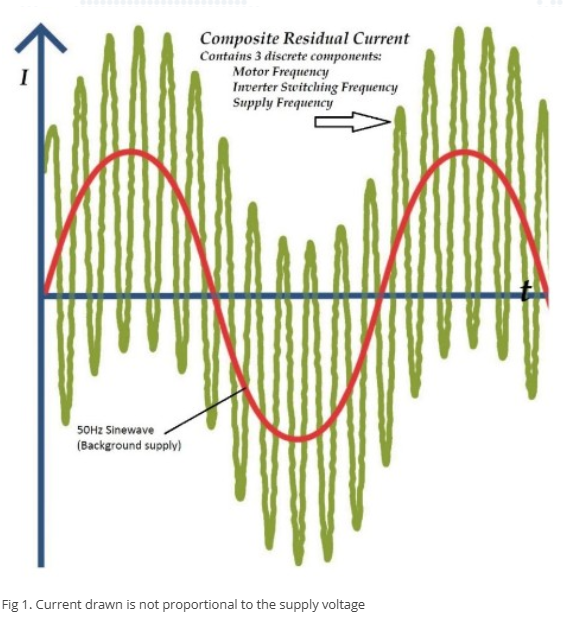
Today’s single phase appliances incorporating energy efficiency rely on complex electronics to control motor speed. These systems produce complex (composite) residual currents containing multiple frequency components resulting from the mains, inverter and motor.
Type A RCDs are not designed to detect composite residual currents.
Type F are designed for use in single phase inverter applications that do not require the complexity of Type B RCDs
What Is a Type F RCCB?
Type F RCCBs are specifically designed to detect composite residual currents – see Regulation 531.3.3 (iii)(a) i.e. the behaviour of the RCD is defined, its tripping characteristic is not random, as may be the case with Type A RCDs subjected to different frequencies.
Detecting Composite Residual Currents
In addition to the requirements of EN 61008 or EN 61009 for Type A currents, Type F must also meet EN 62423: Composite residual current containing three frequency components, based on the rated residual operating current I∆n of the RCD and its rated frequency.
Type F responds to: Pure AC residual currents, Pulsating DC residual currents, Mixed frequency residual current from 10Hz to 1kHz. Maximum Smooth DC components up to 10 mA
Where Type F RCCBs Should Be Used
Type F is recommended for circuits supplying: Washing machines with single phase inverter motors, small wall mounted Heat pumps and Air conditioning units. Tumble dryers, Dishwashers and LED lighting.
Other common applications using single phase inverters, pumps, tools, battery charging. Mode 3 Charging of certain vehicles may require Type F.
Operational leakage currents and residual currents associated with circuits containing non – linear loads i.e. current drawn is not proportional to the supply voltage, will consist of mixed frequency components creating a composite residual current - see Figure 1.
Type F Detection Technology
Manufactures use various detection systems. The Doepke Type F uses a sophisticated, patented electronics system, powered from the energy within the summation current transformer, generated by the residual current. Therefore, the residual current circuit-breaker works independent of supply voltage for the detection of Type A and Type F residual currents.
Conclusion
Modern day appliances under fault conditions produce complex composite residual currents. This requires more sophisticated protection in the form of a type F RCCB to EN 61008 and EN 62423.
You should always check the equipment manufactures instructions, as some single-phase inverters require the use of Type B RCDs. This is due to the individual inverter design frequency characteristics and the level of smooth DC residual current produced under certain fault conditions.
Written by Martin Plumbridge – TMIET, Doepke Technical manager.
See more from Voltimum on Google
Add Voltimum as a preferred source and Google will show our articles more often in your news results.