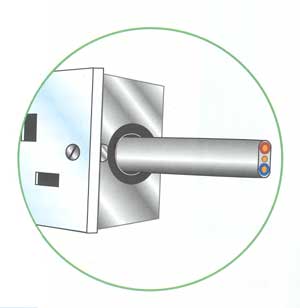
The cores of a cable from which the sheath has been removed must be properly enclosed.

Instances are often found of exposed cable cores, as shown in the diagram, resulting from the removal of an excessive amount of the sheath cable. The cable cores are exposed meaning there is an increased risk of electric shock.
Solution
Care must be taken when removing the sheath of a cable to expose the cores in that a sufficient, but not excessive amount, of the sheath should be removed. A cable, such as a pvc/pvc insulated and sheathed cable, when properly installed provides protection against electric shock (Regulation 471-09-04 refers). In most cases, such as the example shown, the sheath of the cable must enter the accessory (Regulation 526-03-03 refers). Cable sheaths must be protected from any sharp edges at the enclosure by deburring or providing a suitable grommet. Enclosures must, in almost every case, provide at least a degree of protection of IP2X or IPXXB (which prevents the entry of solid objects exceeding 12.5 mm diameter, for example, a finger or tools.
Definition:
Enclosure: A part providing protection of equipment against certain external influences and in any direction protection against direct contact.
Regulation 471-09-04
Cable having a non-metallic sheath or a non-metallic enclosure shall not be described as being of Class II construction. However, the use of such cable installed in accordance with Chapter 52 shall be deemed to afford satisfactory protection against direct and indirect contact.
Regulation 526-03-03
Cores of sheathed cables from which the sheath has been removed and non-sheathed cables at the termination of conduit, ducting or trunking shall be enclosed as required by Regulation 526-03-02
Regulation 526-03-02
Every termination and joint in a live conductor or a PEN conductor shall be made within one of the following or a combination thereof:
(i) a suitable accessory complying with the appropriate British Standard
(ii) an equipment enclosure complying with the appropriate British Standard
(iii) a suitable enclosure of material complying with the glow-wire test requirements of BS 6458-2.1
(iv) an enclosure formed or completed with building material considered to be non-combustible when tested to BS 476-4
(iv) an enclosure formed or completed by part of the building structure, having the ignitability characteristic 'P' as specified in BS 476 Part 5.