























































-Promo-graphics.png?width=1280)
-Promo-graphics-(1).png?width=800)


Earth leakage testing has become an increasingly critical part of modern electrical verification and maintenance, particularly as installations age and the cumulative effects of leakage currents become more pronounced. With the widespread use of RCDs and RCBOs providing life-saving protection, understanding, identifying, and managing earth leakage is essential to ensure both safety and reliability.
What is Earth Leakage?
Earth leakage refers to the unintended flow of electrical current from a circuit to earth. This can occur due to insulation breakdown, damaged conductors, moisture ingress, or faulty equipment. Even in healthy installations, small amounts of leakage are inevitable due to the design of modern electrical equipment. However, while these currents are typically harmless in isolation, their cumulative effect across multiple circuits can create significant issues.
RCBOs and Nuisance Tripping
RCBOs and RCDs are designed to detect imbalances between live and neutral conductors and disconnect the supply rapidly, often within milliseconds, when leakage exceeds a set threshold, typically 30mA in domestic settings. This function is crucial in preventing electric shock and reducing the risk of fire. However, these are not selective devices; they respond to total leakage on the circuits they protect. As a result, they can be susceptible to “nuisance tripping” when leakage currents approach their operating threshold without an actual fault being present.
An increasing challenge with modern installations
This challenge is becoming more common due to two key factors: ageing circuits and the rise of modern electronic loads. Over time, cable insulation degrades, becoming brittle, cracked, or moisture-affected, all of which create pathways for leakage current. These faults are often hidden within walls or under floors, making them difficult to detect without proper testing. In parallel, modern installations now include devices such as LED drivers, EV chargers, electric showers, air-conditioning, and switch-mode power supplies, all of which contribute small but continuous leakage currents.
Individually, these leakage currents may only amount to a few milliamps, but when combined across several circuits, particularly on split-load consumer units, they can approach or exceed the protective device’s trip threshold. Cumulative leakage from cable capacitance, appliances, and transient events can easily reach 10–18 mA on a 30mA RCBO or RCD, leaving very little headroom before unwanted tripping occurs. This is especially problematic in older installations where insulation resistance has already declined.
The dangers
The danger here is twofold. Firstly, nuisance tripping can lead to inconvenience, loss of power, and potential damage to equipment. More critically, it may mask genuine faults or lead to complacency, where users repeatedly reset protective devices without investigating the underlying issue. Secondly, ageing or inappropriate RCDs and RCBOs may fail to operate correctly under certain conditions, either tripping too easily or, more concerningly, failing to trip when required.
The solution
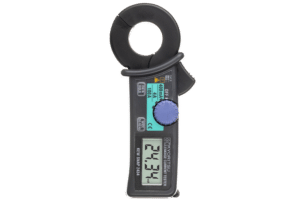
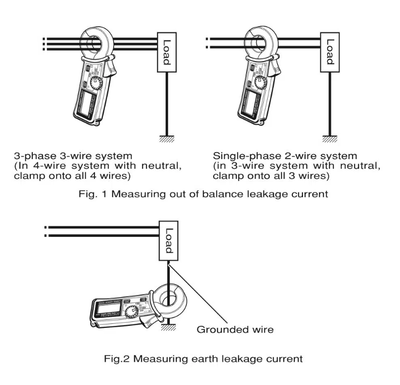
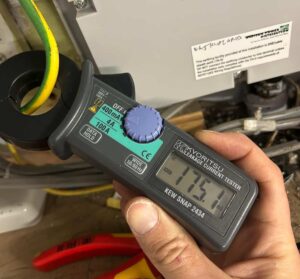
This is where effective earth leakage testing becomes invaluable. Using an earth leakage clamp meter, such as the KEWTECH KEW2434, allows you to measure leakage currents quickly and non-intrusively. This can be achieved by measuring the leakage on the earthing conductors, or by measuring the unbalanced load on the live and neutral conductors simultaneously. This enables the identification of circuits with elevated leakage without the need to disconnect conductors or disrupt the installation.
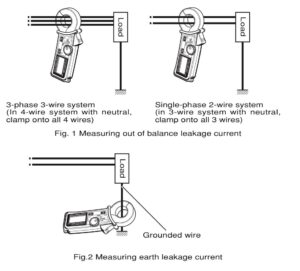
Testing with a clamp meter provides several advantages. It allows for the assessment of total leakage at the origin, followed by the isolation of individual circuits to pinpoint contributors. It also helps differentiate between acceptable “background” leakage and abnormal levels indicating faults. This is particularly important in modern installations where some leakage is unavoidable, and the goal is to manage it rather than eliminate it entirely.
Furthermore, with the vast array of tripping characteristics and types of RCB/RCBO now recommended for various applications; appropriate selection is critical and ‘nuisance tripping’ can be a factor, which is why proper measurements should be taken prior to selection.
The takeaway
As electrical systems continue to age and the number of leakage-producing devices increases, proactive earth leakage testing is no longer optional but is essential. RCDs/RCBOs remain a cornerstone of electrical safety, but their effectiveness depends on the condition of the installation and the level of leakage present. By incorporating tools such as an earth leakage clamp meter into routine testing, electricians can identify issues early, reduce nuisance tripping, and ensure that protective devices operate as intended, ultimately safeguarding both property and lives.
See more from Voltimum on Google
Add Voltimum as a preferred source and Google will show our articles more often in your news results.