
























































-Promo-graphics.png?width=1280)
-Promo-graphics-(1).png?width=800)

We have witnessed an increase in reports from several well-informed installers relating to type B’s that do not function correctly in the presence of DC components.

For example, one design was marked as bidirectional but failed smooth DC tripping test. Although the basic requirements of BS 7671 do not require verification that the Type B RCD protection feature works, it would seem prudent to spend a few minutes checking that modern complex domestic systems costing possibly £10,000 or more are protected by a functioning RCD. A simple test with the correct instrument can be performed to verify that the RCD trips when subject to smooth DC.
RCD tests and thresholds
The existing BS7671 1 x RCD verification test required for example for 30mA RCDs relates to an AC sinusoidal residual current, irrespective of the type of RCD.
All RCCBs subjected to 50Hz residual current are designed to trip between >50% - <100% I∆n, which equates to 15 to 30mA. The max switch off time at 1 x is 0.3s.
Type A, type F, and type B pulsed residual current (50Hz); the tripping current threshold changes to >35% - < 140% I∆n.
Type A (BS EN 61008-1) must still trip with the pulsed waveform superimposed on 6mA smooth DC.
Type F (BS EN 61008-1 and BS EN 62423) must still trip with the pulsed waveform superimposed on 10mA smooth DC.
Type B (BS EN 61008-1 and BS EN 62423) subjected to smooth DC residual current must trip between >50% - <200% I∆n i.e. for 30mA equates to 15 < 60mA DC on both cycles 0° and 180°.
The standards define the tripping thresholds and times based on the residual current components. Although BS 7671 only requires verification of the AC trip threshold irrespective of the type, Michael Peace’s IET Article in Issue 91July 2022 explains that other tests are not precluded.
Why DC Tripping Characteristics Matter
RCD Types A and F use a magnetic core to detect imbalance between live and neutral conductors. Smooth DC residual current above the design current can saturate this core, a phenomenon known as DC blinding.
When the core is saturated, The RCD becomes insensitive to further imbalance. Trip thresholds increase unpredictably; the device may fail to trip entirely. This is a major safety concern because a circuit could carry a dangerous fault current without any protective disconnection.
Type B RCDs are designed to detect smooth DC and trip when it exceeds the default value. This maintains sensitivity to both AC and pulsating DC components while also responding to pure DC leakage.
Test instruments
For test instruments equipped with a Type B RCD setting, a multiplier of 2 × I∆n is applied in accordance with the product standard BS EN 62423. We have witnessed an increase in complaints relating to a number of type B’s that do not function correctly in the presence of DC components. Particularly those that are marked as bidirectional. A simple test can be performed to verify DC tripping on DC currents.
Testing procedure for Type B RCDs
The testing procedure for a type B RCD is relatively straight forward from connecting the live, neutral and earth to probes the appropriate terminals on the load side and carrying out the tests. Once complete, carry out the same test on the supply side to check the device is true bidirectional.
Carry out standard AC test first (following all testing safety procedures)
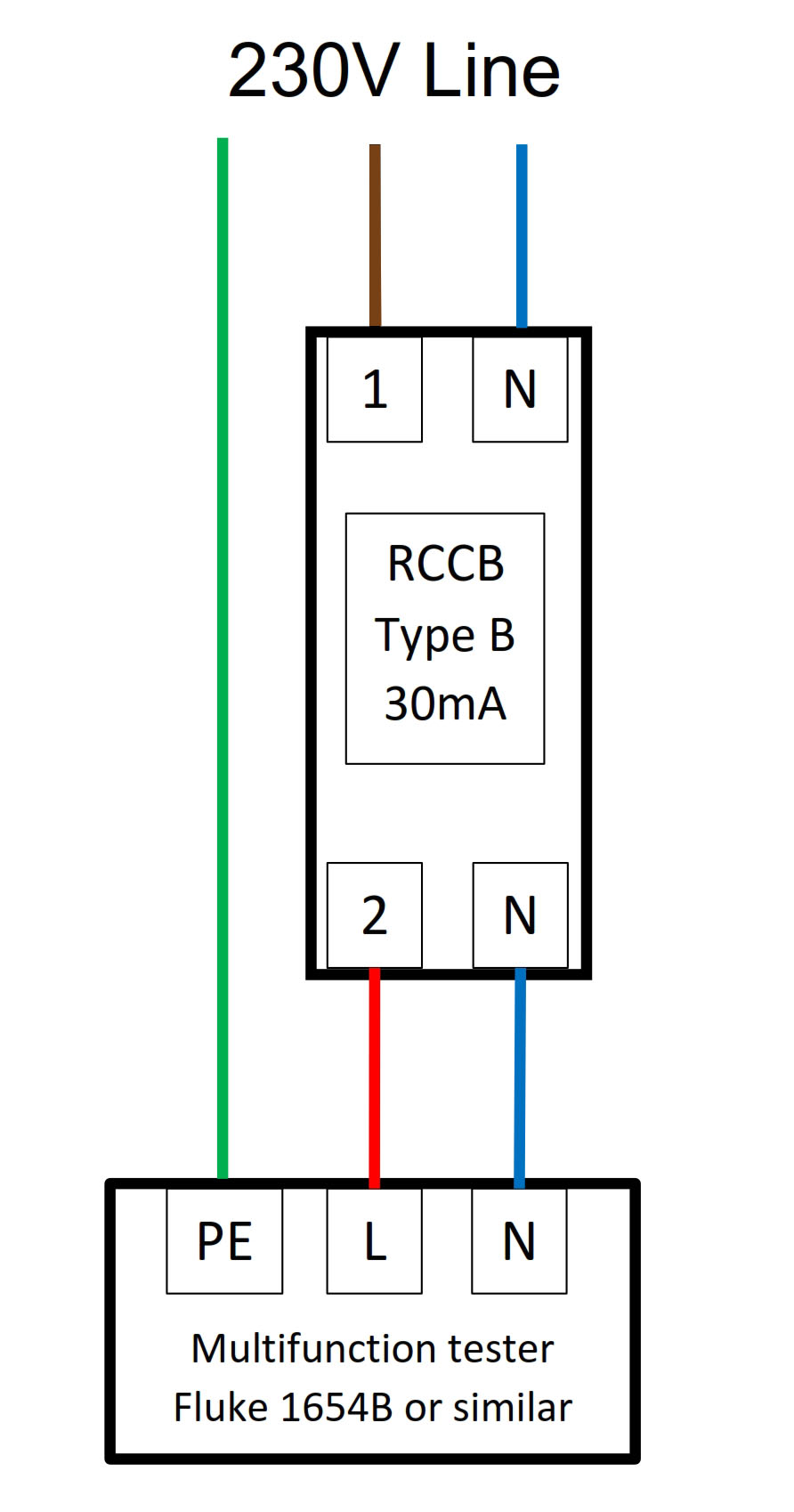
DC Tripping test applicable to any 2-pole 30mA type B (Outgoing circuit should be disconnected)
To measure RCD tripping current on a fluke 1654B
Turn the rotary switch to I∆n position.
press F1 to select the test current phase, 0° or 180°.
press F3 to select the RCD test-current waveform: smooth – DC current to test type B RCD.
press F4 to select the RCD current rating (10,30,100,300 or 500mA).
press and release ‘test. Wait for the test to complete.
Repeat the same test on the opposite side of the For a true bidirectional RCD it should still trip to the relevant parameters.
Conclusion
So, does a Type B RCCB trip on DC? Well, the answer is that it should do but some don’t. If it is detecting DC it should trip between >50% - <200% I∆n, which equates to 15 to 60mA range on both cycles 0° and 180° for 30 mA device. If it is truly bi-directional it will trip on DC irrespective of which side, you connect the supply.
The testing procedure for a type B RCD including DC test takes a few minutes in addition to the standard AC test. If it is complex installation requiring Bi-directional RCD functionality you can verify the operation by repeating the Test on the reverse side
Spend a few additional minutes checking that your modern complex domestic system and the people using it are adequately protected by the RCD you have specified and installed.
Written by Martin Plumbridge – TMIET, Technical manager Doepke.
See more from Voltimum on Google
Add Voltimum as a preferred source and Google will show our articles more often in your news results.