










Published: 7 August 2018
Category: Technical articles
Skip to content
-
-
Premium 8
-
Manufacturer 39
-
 Adaptaflex

-
 APC
APC
-
 BG Electrical
-
 Brady
Brady
-
 British Cables Company
-
 CPN Cudis
-
 Crabtree
-
 Dehn
Dehn
-
 Di-Log
-
 Doepke
-
 E-Klips
-
 Eaton
Eaton
-
 Electrium
-
 Emergi-Lite
-
 Fibox
Fibox
-
 flex7
flex7
-
 Furse
Furse
-
 Interact
-
 Kewtech
-
 KOPEX
KOPEX
-
 LEDVANCE
-
 Linian
-
 Luceco
-
 Marshall Tufflex
-
 Martindale Electric
-
 Masterplug
-
 Megger
-
 Nexans
-
 Philips
-
 Quickwire
-
 Rointe
-
 Shelly
-
 Siemens
-
 Signify
-
 Sync Energy
-
 TWISTTAIL
-
 TY-MET
-
 TY-RAP
-
 Wylex
Wylex
-
-
Distributor 8
- All partners
-
Shopping Cart
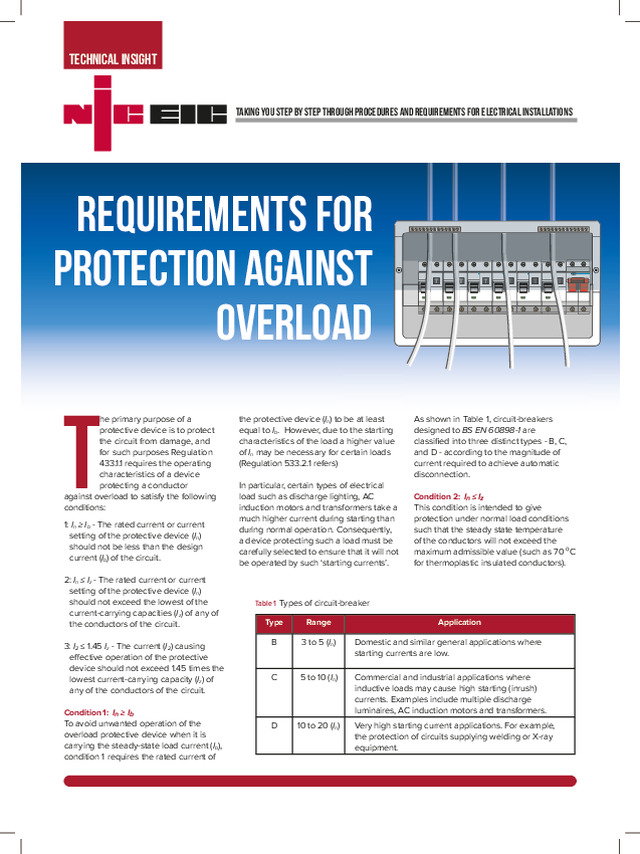

Requirements for protection against overload
Taking you step by step through procedures and requirements for electrical installations
NICEIC
Requirements for protection against overload
Published: 7 August 2018 · Category: Technical articles
Taking you step by step through procedures and requirements for electrical installations
From this document
TECHNICAL INSIGHT TAKING YOU STEP BY STEP THROUGH PROCEDURES AND REQUIREMENTS FOR ELECTRICAL INSTALLATIONS REQUIREMENTS FOR PROTECTION AGAINST OVERLOAD T he primary purpose of a protective device is to protect the circuit from damage, and for such purposes Regulation 433.1.1 requires the operating characteristics of a device protecting a conductor against overload to satisfy the following conditions: 1: In ≥ Ib - The rated current or current setting of the protective device (In) should not be less than the design current (Ib) of the circuit. 2: In ≤ Iz - The rated current or current setting of the protective device (In) should not exceed the lowest of the current-carrying capacities (Iz) of any of the conductors of the circuit. 3: I2 ≤ 1.45 Iz - The current (I2) causing effective operation of the protective device should not exceed 1.45 times the lowest current-carrying capacity (Iz) of any of the conductors of the circuit. the protective device (In) to be at least equal to Ib. However, due to the starting characteristics of the load a higher value of In may be necessary for certain loads (Regulation 533.2.1 refers) In particular, certain types of electrical load such as discharge lighting, AC induction motors and transformers take a much higher current during starting than during normal operation. Consequently, a device protecting such a load must be carefully selected to ensure that it will not be operated by such ‘starting currents’. Condition 2: In ≤ Iz This condition...
Open the PDF