
















Published: 4 May 2021
Category: White Papers and technical guides
Skip to content
-
-
Premium 8
-
Manufacturer 39
-
 Adaptaflex

-
 APC
APC
-
 BG Electrical
-
 Brady
Brady
-
 British Cables Company
-
 CPN Cudis
-
 Crabtree
-
 Dehn
Dehn
-
 Di-Log
-
 Doepke
-
 E-Klips
-
 Eaton
Eaton
-
 Electrium
-
 Emergi-Lite
-
 Fibox
Fibox
-
 flex7
flex7
-
 Furse
Furse
-
 Interact
-
 Kewtech
-
 KOPEX
KOPEX
-
 LEDVANCE
-
 Linian
-
 Luceco
-
 Marshall Tufflex
-
 Martindale Electric
-
 Masterplug
-
 Megger
-
 Nexans
-
 Philips
-
 Quickwire
-
 Rointe
-
 Shelly
-
 Siemens
-
 Signify
-
 Sync Energy
-
 TWISTTAIL
-
 TY-MET
-
 TY-RAP
-
 Wylex
Wylex
-
-
Distributor 8
- All partners
-
Shopping Cart

Planning your building controls and building energy management system (BEMS) - Part 2
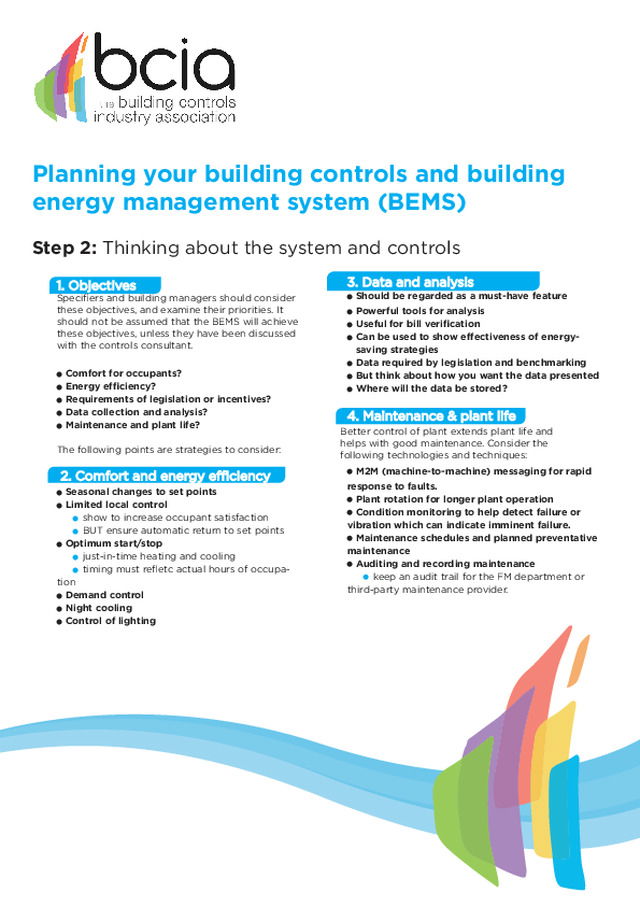
Step 2: Thinking about the system and controls Specifiers and building managers should consider these objectives, and examine their priorities. It should not be assumed that the BEMS will achieve these objectives, unless they have been discussed with the controls consultant.
BCIA
Planning your building controls and building energy management system (BEMS) - Part 2
Published: 4 May 2021 · Category: White Papers and technical guides
Step 2: Thinking about the system and controls Specifiers and building managers should consider these objectives, and examine their priorities. It should not be assumed that the BEMS will achieve these objectives, unless they have been discussed with the controls consultant.
From this document
Planning your building controls and building energy management system (BEMS) Step 2: Thinking about the system and controls Specifiers and building managers should consider these objectives, and examine their priorities. It should not be assumed that the BEMS will achieve these objectives, unless they have been discussed with the controls consultant. Comfort for occupants? Energy efficiency? Requirements of legislation or incentives? Data collection and analysis? Maintenance and plant life? The following points are strategies to consider: Should be regarded as a must-have feature Powerful tools for analysis Useful for bill verification Can be used to show effectiveness of energysaving strategies Data required by legislation and benchmarking But think about how you want the data presented Where will the data be stored? Better control of plant extends plant life and helps with good maintenance. Consider the following technologies and techniques: M2M (machine-to-machine) messaging for rapid Seasonal changes to set points Limited local control show to increase occupant satisfaction BUT ensure automatic return to set points Optimum start/stop just-in-time heating and cooling timing must refletc actual hours of occupation Demand control Night cooling Control of lighting response to faults. Plant rotation for longer plant operation Condition monitoring to help detect failure or vibration which can indicate imminent failure. Maintenance schedules and planned preventative...
Open the PDF