










Published: 4 May 2021
Category: White Papers and technical guides
Skip to content
-
-
Premium 8
-
Manufacturer 39
-
 Adaptaflex

-
 APC
APC
-
 BG Electrical
-
 Brady
Brady
-
 British Cables Company
-
 CPN Cudis
-
 Crabtree
-
 Dehn
Dehn
-
 Di-Log
-
 Doepke
-
 E-Klips
-
 Eaton
Eaton
-
 Electrium
-
 Emergi-Lite
-
 Fibox
Fibox
-
 flex7
flex7
-
 Furse
Furse
-
 Interact
-
 Kewtech
-
 KOPEX
KOPEX
-
 LEDVANCE
-
 Linian
-
 Luceco
-
 Marshall Tufflex
-
 Martindale Electric
-
 Masterplug
-
 Megger
-
 Nexans
-
 Philips
-
 Quickwire
-
 Rointe
-
 Shelly
-
 Siemens
-
 Signify
-
 Sync Energy
-
 TWISTTAIL
-
 TY-MET
-
 TY-RAP
-
 Wylex
Wylex
-
-
Distributor 8
- All partners
-
Shopping Cart
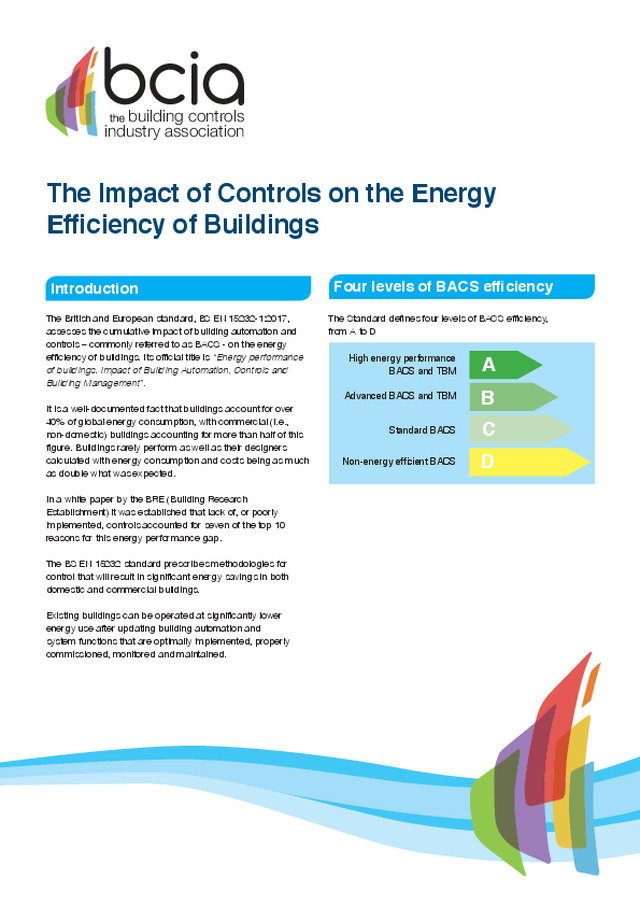

The Impact of Controls on the Energy Efficiency of Buildings
The British and European standard, BS EN 15232-1:2017, assesses the cumulative impact of building automation and controls – commonly referred to as BACS - on the energy efficiency of buildings. Its official title is “Energy performance of buildings. Impact of Building Automation, Controls and Building Management”.
BCIA
The Impact of Controls on the Energy Efficiency of Buildings
Published: 4 May 2021 · Category: White Papers and technical guides
The British and European standard, BS EN 15232-1:2017, assesses the cumulative impact of building automation and controls – commonly referred to as BACS - on the energy efficiency of buildings. Its official title is “Energy performance of buildings. Impact of Building Automation, Controls and Building Management”.
From this document
building controls industry association The Impact of Controls on the Energy Efficiency of Buildings Introduction Four levels of BACS efficiency The British and European standard, BS EN 15232-1:2017, assesses the cumulative impact of building automation and controls – commonly referred to as BACS - on the energy efficiency of buildings. Its official title is “Energy performance of buildings. Impact of Building Automation, Controls and Building Management”. The Standard defines four levels of BACS efficiency, from A to D It is a well-documented fact that buildings account for over 40% of global energy consumption, with commercial (i.e., non-domestic) buildings accounting for more than half of this figure. Buildings rarely perform as well as their designers calculated with energy consumption and costs being as much as double what was expected. High energy performance BACS and TBM A Advanced BACS and TBM B Standard BACS C Non-energy efficient BACS D In a white paper by the BRE (Building Research Establishment) it was established that lack of, or poorly implemented, controls accounted for seven of the top 10 reasons for this energy performance gap. The BS EN 15232 standard prescribes methodologies for control that will result in significant energy savings in both domestic and commercial buildings. Existing buildings can be operated at significantly lower energy use after updating building automation and system functions that are optimally implemented, properly commissioned,...
Open the PDF